
Microsoft priced day-one Call of Duty twice and the answer was no
Game Pass Ultimate went to $29.99 with day-one Call of Duty, then down to $22.99 without it. Microsoft ran the experiment in public and published the result.

Six months. That’s the gap between Microsoft raising Game Pass Ultimate to $29.99 with day-one Call of Duty as the headline justification, and Microsoft dropping Ultimate to $22.99 with day-one Call of Duty as the thing being taken away. Same product, same executive team, two opposite prices for the same feature, both announced in public with a straight face.
Put those two announcements side by side and you’re looking at something the subscription era has almost never produced. A real experiment. Microsoft put a number on what day-one Call of Duty inside a subscription is worth to it, watched what happened, then put a second number on what it’s worth to not do that. Between the two data points sits a subscriber count that went the wrong way by millions.
My read is blunt: Microsoft tested whether day-one Call of Duty could carry a $10 monthly premium, found out it couldn’t, and walked it back. Nobody at Xbox has said that in those words and nobody will. But you can price a thing in and price a thing out inside two fiscal quarters and the market will read the receipts for you.
What actually changed in October 2025
The 1 October restructure did two things at once, and most coverage only followed one of them. The renaming was cosmetic. Core became Essential, Standard became Premium, Ultimate kept its name. Fine, whatever.
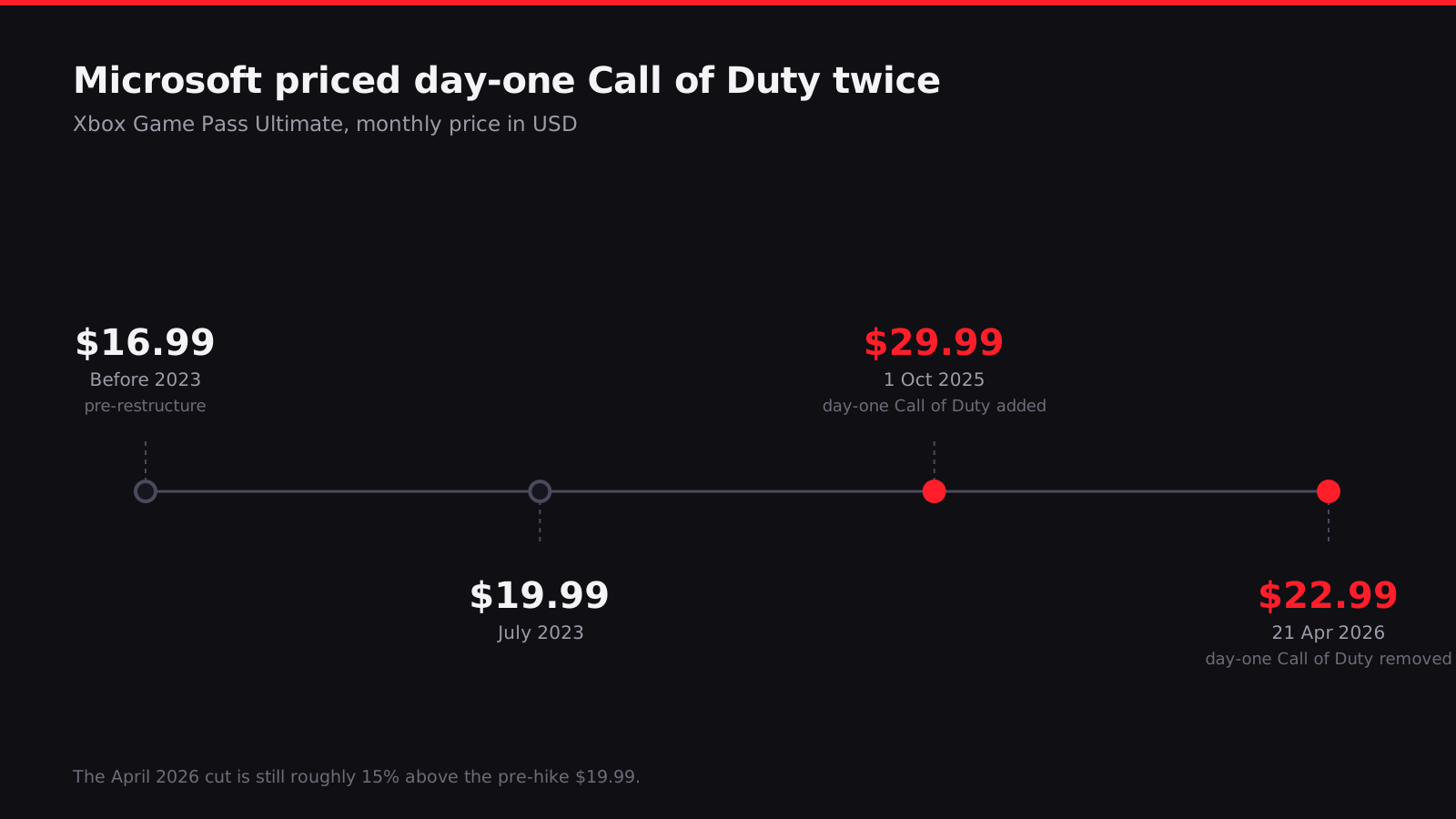
The real move was the money. Ultimate went from $19.99 to $29.99 a month, a 50% increase. PC Game Pass went from $11.99 to $16.49, up 37.5%. Essential and Premium held, at $10.99 and $16.99 by the figures I’d trust most, though I’ll flag that plenty of outlets reported $9.99 and $14.99 for those two tiers and the discrepancy never got cleanly resolved. Treat the middle of the stack as approximate.
What Microsoft put in the shop window to justify the 50% was value density. Ultimate now carried 400-plus games, 75-plus day-one titles a year, every Xbox release on launch day, Ubisoft+ Classics folded in, the Fortnite Crew Bundle, best-quality cloud streaming, and Rewards worth up to $100 a year. The official line was that Game Pass was “evolving to offer more flexibility, choice, and value to all players.”
Look at that list again. The load-bearing item is “all Xbox releases on day one”, and in October 2025 that meant Black Ops 7. Everything else is padding by comparison. Ubisoft+ Classics is a nice-to-have. A Fortnite cosmetics bundle is a coupon. The pitch was: pay us fifty percent more and the biggest annual release in the industry lands in your library at no extra cost.
The rollout was messier than the announcement. New subscribers hit the new price immediately, existing subscribers from around 4 November. But auto-renewing subscribers in Germany, Ireland, South Korea, Poland and India kept their old rates, which Xbox communications head Kari Perez explained as continuing “at their existing price for now, in line with local requirements.” Cancel and re-subscribe and you lost that protection. Microsoft promised at least 60 days’ notice on future changes.
Then the backlash. Reporting from the days after describes Microsoft’s own cancellation page going down under load, GameStop happily selling codes at the old price and needling Microsoft while it did, and players buying up stacks of prepaid cards to lock in old rates. I can’t independently verify the finer details of that scramble, so take the specifics loosely. The direction of travel is not in dispute.
The number Microsoft stopped talking about
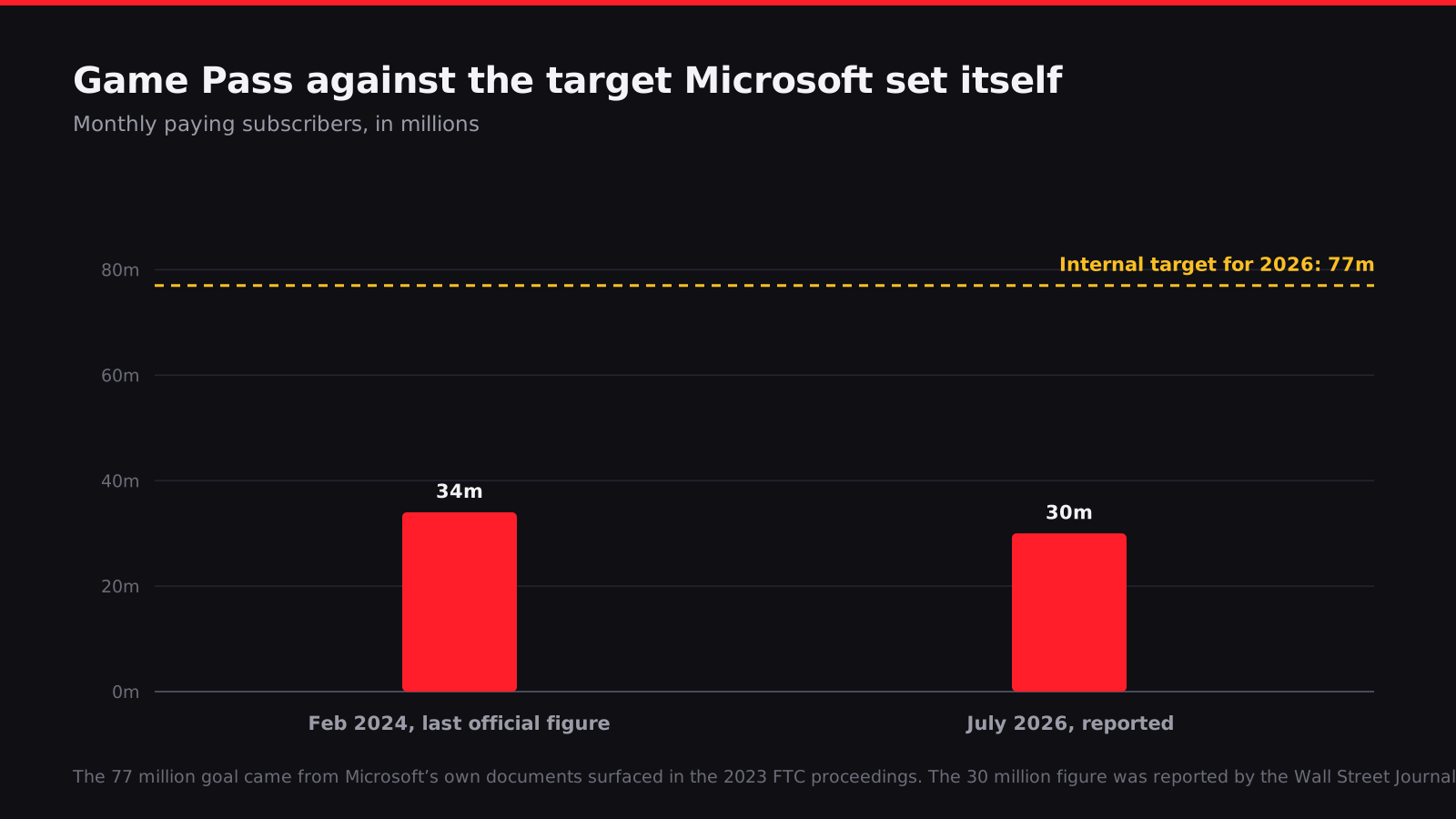
Here’s where it gets genuinely awkward. Microsoft’s last official Game Pass subscriber figure is 34 million, given by then-Xbox President Sarah Bond in February 2024. That’s two and a half years ago as I write this. There has been no update since, which by itself tells you roughly everything.
In July 2026 the Wall Street Journal reported the service at about 30 million monthly paying customers, sourced to a person familiar with the matter. The WSJ framing was the killer part: “The company had projected Game Pass subscriptions would reach around 77 million this year… It currently has about 30 million.”
That 77 million isn’t a journalist’s guess or an analyst model. It came out of Microsoft’s own internal documents, surfaced during the 2023 FTC proceedings over the Activision deal, alongside a stated ambition of 100 million paid members by 2030. So the gap isn’t 30 versus some pundit’s fantasy. It’s 30 versus Microsoft’s own plan, and it’s not close. It’s short by more than the entire current subscriber base.
Two named executives have conceded it. Matthew Ball, hired as Xbox Chief Strategy Officer in 2026, said the $30 move meant “we shed millions of subscribers over the span of a few months.” Asha Sharma, Xbox CEO, said the service “did not grow at the pace we expected.” Ball’s line is the more useful of the two because it’s causal. He’s not saying growth slowed. He’s saying the price rise drove people out, quickly, in the millions.
Now, the honest counterweight. Game Pass revenue crossed roughly $5 billion annually in FY2025, a first for the service, and in the same quarter Microsoft became the top publisher on both Xbox and PlayStation off the back of Forza Horizon 5 and Oblivion Remastered. Nadella said so on the call. So the business isn’t shrinking in dollar terms even as the headcount slips, which is what happens when you push ARPU up faster than you lose bodies.
But notice the fiscal year. FY2025 ended in June 2025, three months before the hike. That $5 billion is the pre-experiment baseline, not proof the experiment worked.
For the post-hike picture you want Q2 FY26, the quarter ending 31 December 2025, which is the first full holiday under $29.99 with Black Ops 7 in the box. Xbox hardware revenue fell 32% year on year. Content and services fell 5%. Total Microsoft gaming revenue fell 9%. If a 50% price rise on your flagship tier bundled with the biggest game of the year can’t hold content and services flat, the increase did not clear its own hurdle.
The walk-back, and what it admits
21 April 2026. Ultimate goes from $29.99 to $22.99. PC Game Pass from $16.49 to $13.99. Effective immediately, globally.
And the trade, in Microsoft’s own words: “Beginning this year, future Call of Duty titles won’t join Game Pass Ultimate or PC Game Pass at launch.” New entries turn up roughly a year later, during the following holiday. Existing Call of Duty titles stay put.
The Xbox Wire post is signed “Team XBOX” with no named executive attached, which is its own kind of statement. The closest it gets to an explanation: “Our players cover a wide breadth of geographies, preferences, and tastes, so while there isn’t a single model that’s best for everyone, this change responds to a lot of feedback we’ve gotten so far.”
You’ll see a quote floating around attributing something much franker to Asha Sharma about Ultimate having become too expensive for too many players. I looked for it. It isn’t in the Xbox Wire post, which carries no named quote at all, and I couldn’t verify it anywhere I trust. So I’m not using it, and you should be sceptical of any piece that leans on it.
| Tier | Before Oct 2025 | 1 Oct 2025 | 21 Apr 2026 |
|---|---|---|---|
| Ultimate | $19.99 | $29.99 | $22.99 |
| PC Game Pass | $11.99 | $16.49 | $13.99 |
| Essential (was Core) | $10.99 | $10.99 | $10.99 |
| Premium (was Standard) | $16.99 | $16.99 | $16.99 |
Read the top row as a single sentence and the argument writes itself. Microsoft valued day-one Call of Duty at $10 a month in October. In April it valued the same feature at a $7 discount going the other way, which means it now prefers holding $22.99 without the game to holding $29.99 with it. Somewhere between those two positions is Microsoft’s actual internal estimate of what day-one Call of Duty on a subscription costs it in lost game sales, and the fact that it moved means the number was worse than the subscription revenue it bought.
Microsoft priced the cannibalisation in one direction, then priced it in the other, six months apart, in public. That is as close to a natural experiment as this industry gets.
And please, nobody call $22.99 a restoration. It’s about 15% above the $19.99 that stood before October, and roughly 35% up on where Ultimate sat two years earlier, when it was $16.99 before the 2024 increase. What Microsoft did was retreat to a defensible position while keeping most of the ground it took. Classic. The tier is cheaper than it was in November and more expensive than it was in September, and the biggest annual game in the world left the building. If you subscribed for Call of Duty, you got a price cut and a downgrade in the same email.
Xbox’s own studios have been saying this out loud
The commercial argument is one thing. The internal one is uglier, and it’s the part that convinced me the walk-back wasn’t just a pricing correction.
Jason Schreier, on the Triple Click podcast in July 2026, put it about as directly as a Bloomberg reporter is going to: “There are a lot of people out there in studio leadership within Xbox who absolutely detest Game Pass. [They] think it has destroyed the value of their games.”
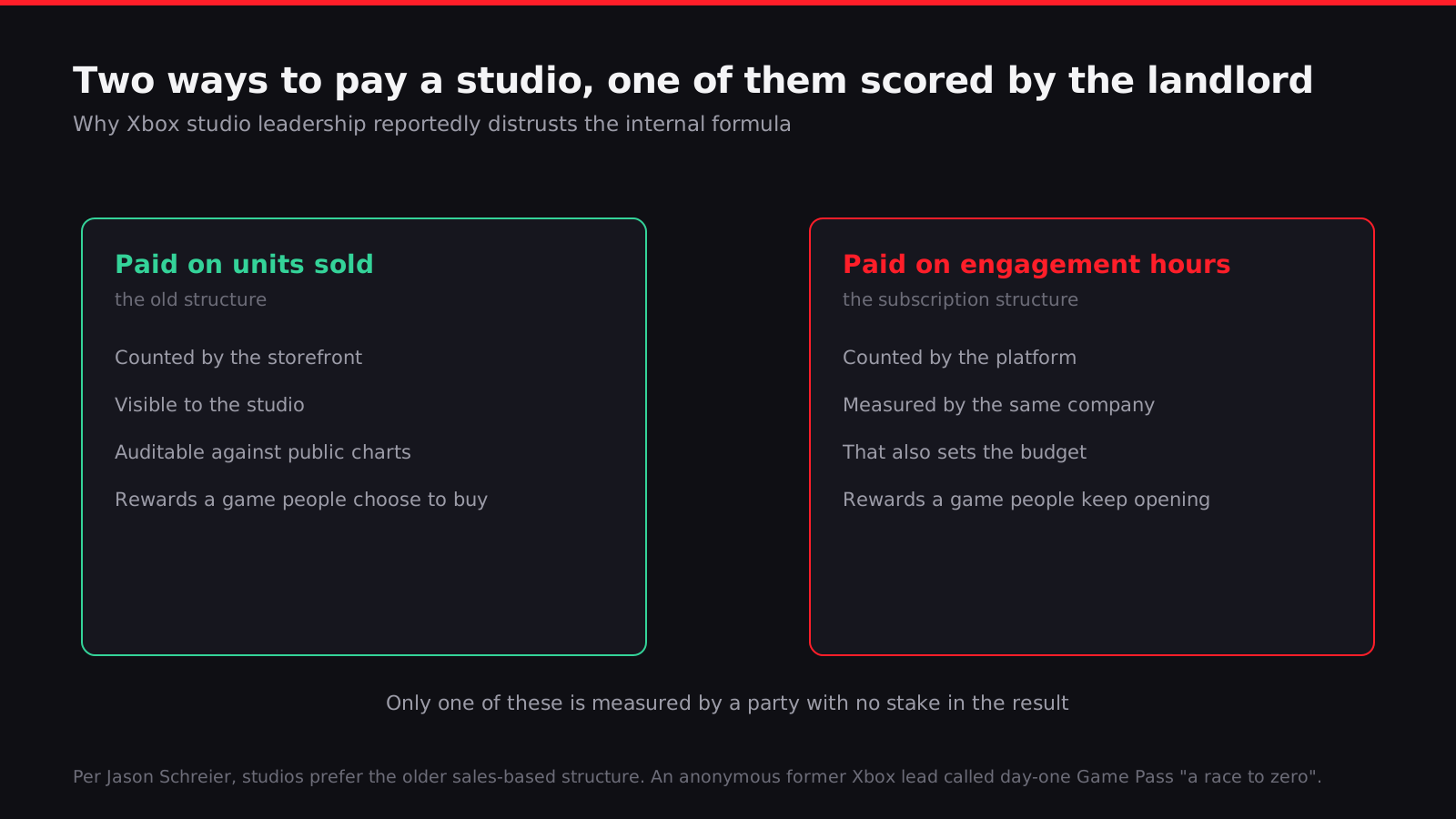
An anonymous former Xbox studio lead in the same reporting described day-one Game Pass as creating “an assumption that these titles could not sell on their own,” and called it “a race to zero.” That’s the line I keep coming back to. It isn’t a complaint about revenue share. It’s a complaint about identity. If your game ships free to everyone who already pays $23 a month, the number that tells you whether you made something people wanted stops existing. You get engagement hours instead.
Which leads to the second grievance in that reporting, and it’s the more concrete of the two. Xbox compensates studios internally on an engagement-based formula, and studios reportedly distrust it and would rather have the old sales-based structure back. Of course they would. Engagement metrics are set by the platform, adjusted by the platform, and audited by the platform. Unit sales are set by strangers with credit cards. One of those you can argue with. The other one you can’t, which is exactly what makes it worth having.
There’s also a Forza Horizon 5 creative director quote doing the rounds to the effect that Game Pass was a good idea that didn’t work. I found the headline but not a version of the full quote I’d stand behind, so I’ll leave it as reported sentiment rather than treat it as evidence.
Worth remembering that Microsoft used to argue the exact opposite position in court. When the FTC called the newly created Game Pass Standard tier at $14.99 a “degraded product” in its July 2024 Ninth Circuit filings, and pointed at Ultimate rising from $16.99 to $19.99 as part of the same pattern, Microsoft’s 19 July response called that a “misleading, extra-record account of the facts.” Its defence was that Standard actually offered more than the tier it replaced because it bundled multiplayer, previously $9.99 on top of a $10.99 tier for a combined $20.98, and that Ultimate members got day-and-date Black Ops 6, a first for the franchise.
Two years later Microsoft removed day-one Call of Duty from Ultimate as a cost-saving measure and cut the price to compensate. The FTC’s word for that structure was product degradation. Microsoft’s word for it in 2026 was responding to feedback. Same shape, different label.
The defence, given properly
I want to give the pro-subscription side a fair run, because the “Game Pass killed Xbox software” narrative is popular, tidy and partly wrong.
Guy Richards, Global Director of ID@Xbox, made the case in April 2026: “One of the great benefits of launching into Game Pass on day one is the discovery that comes with it.” He describes a viral snowball effect, day-one Game Pass games driving Steam wishlists and PC sales, and says “games that are launching day one into Game Pass tend to do very well on other platforms as well.” He also confirmed Microsoft negotiates bespoke financial deals per developer plus extra marketing support.
I believe him about the mechanism. Being in front of tens of millions of people who don’t have to decide anything is genuinely useful for a small game nobody has heard of, and the wishlist bump is real and observable if you’re the developer watching your own dashboard.
Two caveats though, and they’re load-bearing. Richards gave no numbers. Not one. And he runs the programme, so he’s the least neutral person in the conversation. Also, “great for a $20 indie discovering an audience” and “great for a $70 first-party tentpole” are completely different claims. The indie case is about reaching people who’d never have found you. The tentpole case is about people who absolutely would have bought your game choosing not to. Nobody at Xbox has ever explained why one argument should cover both.
Mat Piscatella at Circana is the more interesting sceptic, because he’s on the data side rather than the advocacy side. His position is that the cannibalisation panic is overstated, and he’s drawn the comparison to earlier industry moral panics about piracy and used game sales. That’s a fair shot. Both of those were treated as existential, both got framed as theft of value, and both turned out to be much smaller effects than the rhetoric implied. If your instinct is that day-one subscriptions must be destroying sales, it’s worth remembering how confident everyone was about GameStop’s trade-in shelf killing the industry.
But Piscatella’s own numbers cut the other way on the thing that actually matters here. Non-mobile game subscription spending grew 1% year on year as of mid-2024. One percent. The analysis around that figure argued the addressable market is structurally smaller than the gaming population, because subscriptions suit players who chew through a lot of finite, story-shaped games, and that’s a niche. Most spending sits in infinite live-service titles that no subscription can meaningfully bundle.
So you can hold both ideas at once, and I think you should. Day-one subscription probably isn’t cannibalising sales as brutally as Xbox studio leads believe. And the subscription market probably isn’t big enough to have justified betting the platform on it either. The first point defends Game Pass as a product. The second one indicts it as a strategy, which is the more expensive mistake.
The counterpoint that ruins the easy story
Here’s the fact that should make anyone pushing a clean “Game Pass destroyed Xbox software” thesis slow down.
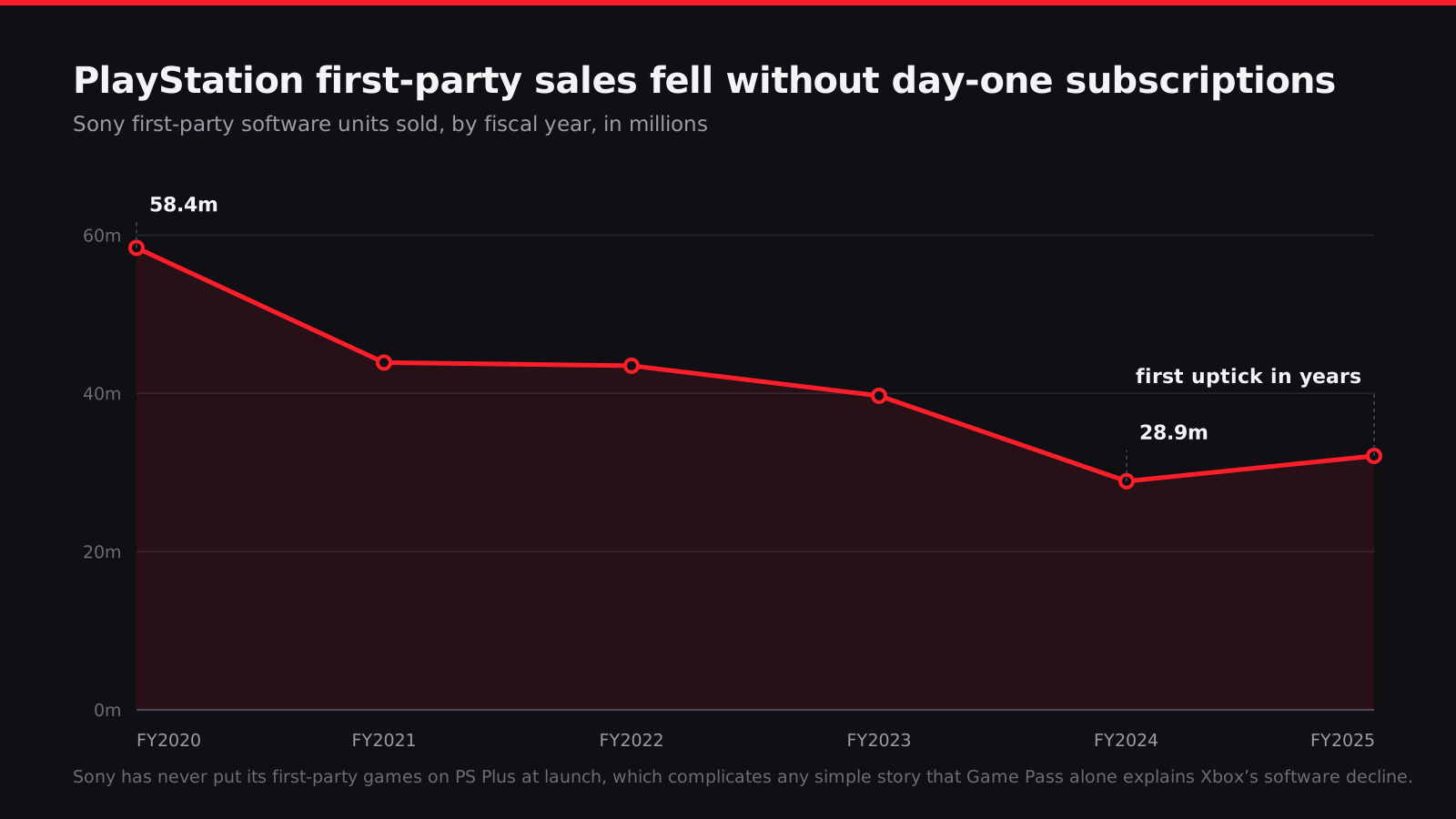
PlayStation first-party software units by fiscal year: 58.4 million in FY2020, 43.9m in FY2021, 43.5m in FY2022, 39.7m in FY2023, 28.9m in FY2024. Then a first uptick in years, 32.1m in FY2025.
That’s a fall of more than half from peak. Sony has never put its first-party games on PS Plus at launch. There was no day-one subscription cannibalising anything. Whatever hollowed out premium first-party volume over those five years, it hollowed Sony out too, and Sony wasn’t running the experiment.
You can see the same thinness in the single most encouraging data point Sony has produced lately. Astro Bot sold 1.5 million in nine weeks, and 37% of its buyers had bought no other first-party software. Read that twice. More than a third of the audience for a well-reviewed first-party platformer were people who otherwise buy nothing from Sony’s studios. The premium first-party buyer base isn’t a broad population that subscriptions eroded. It’s thin, title-specific, and it was thin before Game Pass mattered.
So if you want to be intellectually honest about it: day-one Game Pass is at most an accelerant on a fire that was already going. Which is worse for Microsoft, not better, because it means the walk-back doesn’t fix the underlying problem. It just stops one thing making it worse.
The reset this all sits inside
None of the April pricing move makes sense without the financial backdrop, and the backdrop is grim.
The 11 June 2026 reset memo from Asha Sharma and Matt Booty says that over five years Xbox spent more than $20 billion on content, platform and hardware while annual revenue fell by about $500 million. The memo’s own verdict: “Going forward, this cannot continue.” It describes Xbox becoming “over extended” after ZeniMax and the roughly $68.7 to $70 billion Activision deal, and cites console storage component costs up 5x in two years.
Twenty billion dollars spent to lose half a billion in annual revenue. That’s not a strategy that needs tuning.
July 2026 brought 3,200 job cuts, 1,600 immediate and 1,600 across FY27, the fifth round since the Activision close. Xbox parted ways with Double Fine, Compulsion Games, Ninja Theory and Undead Labs. Obsidian, id Software and ZeniMax took hits. Sharma’s framing was that “our core has to be healthy, and that will be necessary but not sufficient”, that Xbox’s operating margins run “three to 10 times lower than comparable businesses”, and, the line that should have got more attention than it did, that Xbox loses 64 cents per dollar invested in independent studios.
Sixty-four cents on the dollar. If that’s the real return on your studio investments, no subscription price solves it. You either fix the cost of making games or you stop making that many.
And on 10 June 2026, on a Bloomberg Tech panel, Sharma was asked whether the Activision deal had paid off and wouldn’t say yes: “I love Activision Blizzard King. Look, it was bought at a time before ChatGPT… it’s hard to say how to think about those decisions.” That’s a CEO declining to defend the biggest acquisition in the history of the medium, on stage, on the record.
Then the quietest and most revealing move of the lot. Sharma’s 31 July 2026 “Four C’s” memo, built around Core, Content, Creation and Connection, positions Game Pass as part of the platform layer with no subscriber metric attached to it at all. The number Microsoft spent seven years training everyone to watch, the one that anchored a 77 million internal target and a 100 million by 2030 ambition, simply isn’t a headline KPI any more. The memo’s featured stat is that user-generated content has driven over 60% of net consumer spending growth outside China since 2021, and that three franchises each clear $1 billion a year.
That’s a company changing the subject, and I mean that as an observation rather than an insult. If subscriber growth is gone, retiring the metric is more honest than restating it every quarter with worse numbers. But you don’t drop a KPI you’re winning on.
So was the walk-back right?
Yes. Obviously yes. Given the choice between holding $29.99 while shedding millions of subscribers and holding $22.99 with a stable base and Call of Duty sales intact, only one of those is a business. Microsoft took about six months to work it out, which for a company that size is quick.
That doesn’t mean the structure it retreated into is any good. Four tiers, two of which have prices I still can’t nail down with confidence, one of which is a multiplayer toll dressed as a games library, and a flagship that costs 15% more than it did last September while carrying less. If you asked a room of people to design a pricing page nobody could explain, you’d get something close to this.
The part I’d actually push on is the framing. Microsoft keeps presenting each of these moves as responding to feedback, evolving the offer, resetting the business. Fine. But October’s hike and April’s cut aren’t two separate acts of listening. They’re one experiment with a result, and the result is that day-one Call of Duty inside a subscription costs Microsoft more than subscribers will pay for it. That’s a genuinely useful finding. It’s the first hard evidence anyone has produced on the central open question of subscription gaming, and Microsoft generated it by accident, at a cost of several million subscribers and a fair chunk of its studios’ goodwill.
What I don’t know is where the line sits. Day-one for a $70 annualised shooter with a live-service tail: no, clearly, Microsoft has now told us twice. Day-one for a small ID@Xbox game with no marketing budget: probably still yes, and Richards is probably right about the wishlist snowball even if he won’t show a number. Day-one for a $70 single-player first-party game that isn’t Call of Duty, something like the next Fable: nobody has any idea, including Microsoft, and the current policy says every Xbox release still lands in Ultimate on launch day.
Which means the experiment isn’t over. It just has one carve-out now.
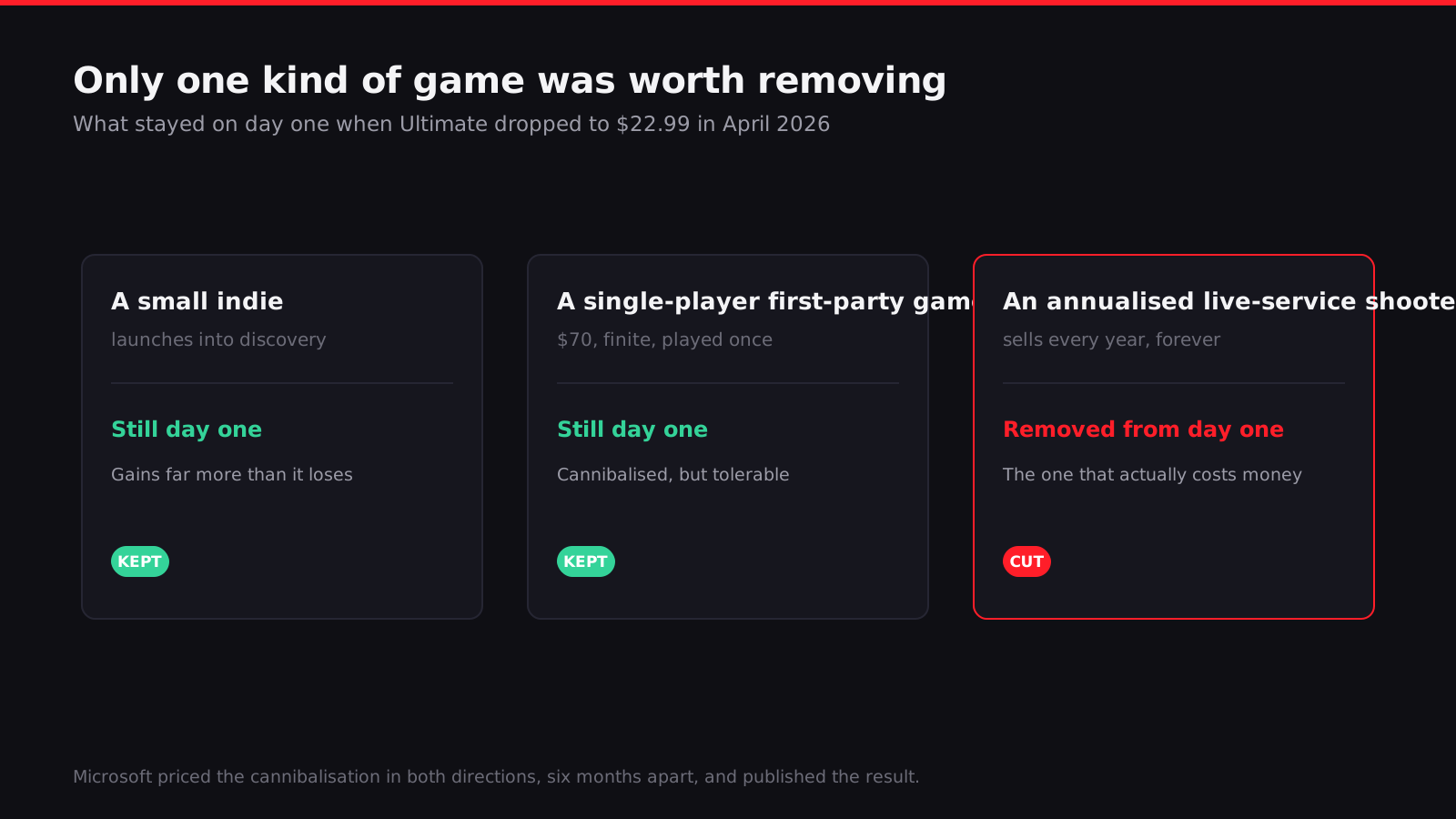
My guess is the carve-out grows. Once you’ve established internally that pulling one franchise out of day-one is worth $7 a month off the sticker price, the same arithmetic works on the next one, and the one after. Watch what happens to the next big Activision or ZeniMax release with a real sales tail attached. If that one shows up in Ultimate a year late as well, then October 2025 wasn’t a pricing mistake Microsoft corrected. It was the moment day-one Game Pass quietly stopped being the point of Game Pass, and nobody sent an email about it.
Read next
The Steam Machine is the most principled console you probably shouldn't buy
Valve's six-inch cube costs $1,049 because Valve refuses to sell hardware below cost. Here is whether that principle, and the engineering behind it, justifies the money.

What Indie Breakouts Actually Cost, and Why the Numbers Don't Add Up
PEAK broke even in hours on a budget under $200,000. But indie sales numbers are a mess of copies, players and estimates dressed up as fact, and that's the story.

Live Service Games Are Built to Die and Nobody Wants to Say It
Highguard lasted 45 days and Destiny 2 lasted a decade, yet both ended the same way. Here's what that says about a business model that can't survive missing.