
The Steam Machine is the most principled console you probably shouldn't buy
Valve's six-inch cube costs $1,049 because Valve refuses to sell hardware below cost. Here is whether that principle, and the engineering behind it, justifies the money.
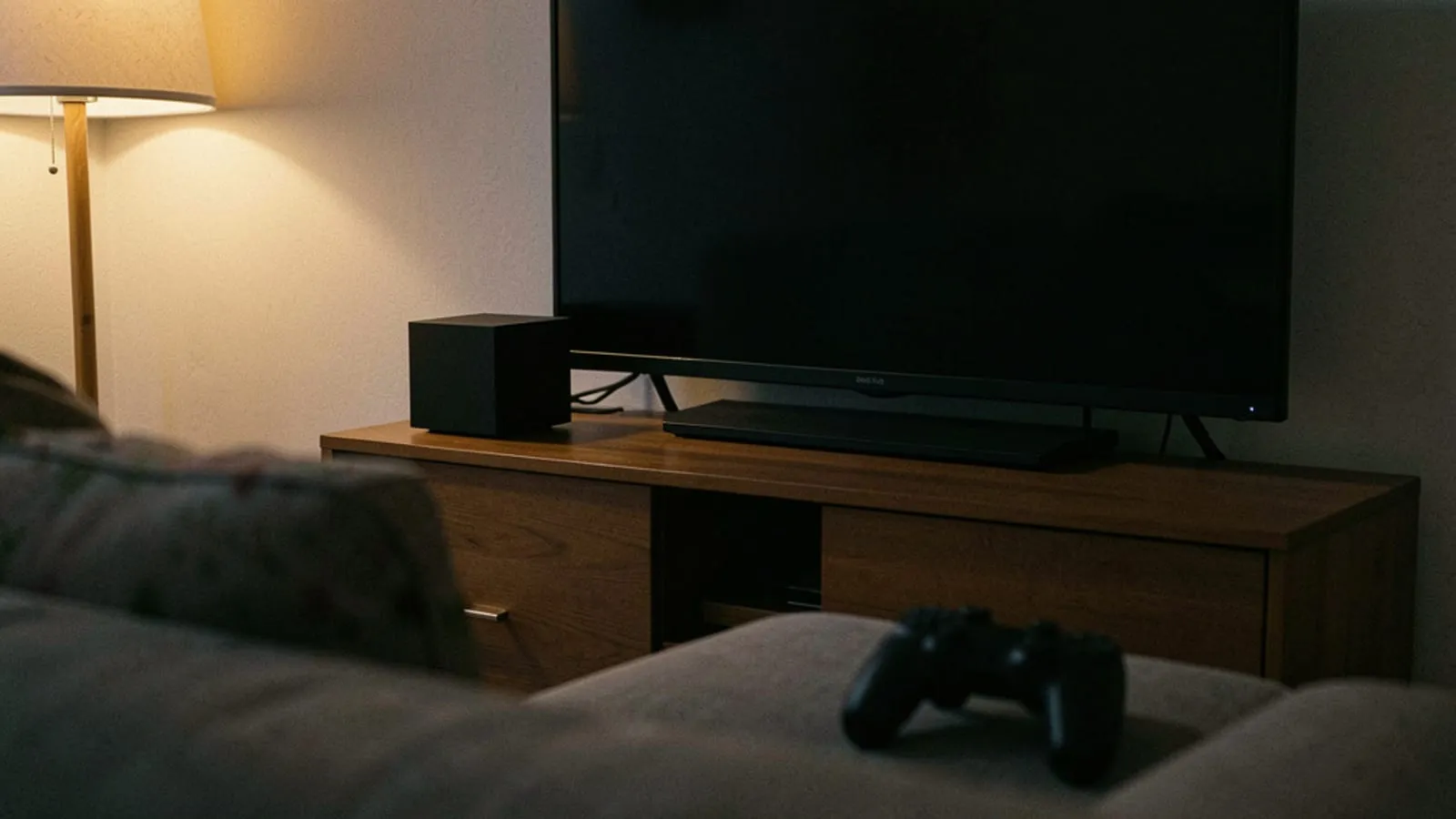
The Steam Machine starts at $1,049 and the reason is DDR5 and GDDR6. Not tariffs, not greed, not some clever margin play that a spreadsheet somewhere will unwind next quarter. Valve said so plainly in its own pricing post back in June, which is more honesty than most hardware companies manage on a good day. What I keep chewing on is the other half of that post, the part where Valve takes the price and turns it into a position.
Here’s the line, and it’s worth reading twice. “When companies sell their hardware under cost for competitive advantage, or buy exclusive content for it, they’re doing that to build a more closed system, one where you don’t get to choose what software you want to use. We don’t want that for PC hardware, and we don’t think you should want it either.” That is not marketing copy. That is an argument, aimed squarely at Sony and Microsoft, and it happens to also be the reason your bank account is $1,049 lighter.
So this piece is about whether the principle survives contact with the price tag. I want to be upfront about what I’m working from, because it matters: this is an assessment built on Valve’s published specs, the interviews its engineers have given, and the critical response, not on a bench of my own frame-time captures. I’m not going to invent numbers I didn’t measure. What I can do is take Valve’s claims and Valve’s own walk-backs seriously, which turns out to be more interesting anyway.
The price is a memory story, and Valve told on itself
Rewind to 12 November 2025. Valve announces the Steam Machine, the Steam Frame and a new Steam Controller, and gives prices for exactly none of them. Griffais offers a philosophy instead: “If you build a PC from parts and get to basically the same level of performance, that’s the general price window that we aim to be at.” Reasonable. Sounds cheap, even, if you were pricing parts in late 2025.
Then 5 February 2026 happens. Valve posts the first slip and doesn’t dress it up. “When we announced these products in November, we planned on being able to share specific pricing and launch dates by now. But the memory and storage shortages you’ve likely heard about across the industry have rapidly increased since then… we must revisit our exact shipping schedule and pricing.” March brought a recommitment to 2026 with a 2027 slip openly on the table. In May, Lawrence Yang sounded like a man who had stopped pretending: “I mean, obviously we’re bummed that this is the state of things. At the very least, we’re not the only ones in this boat.” Steve Cardinali put it in engineer terms, which I found weirdly relatable. “No engineer who designs a product wants to… you’re like right there and then you have this whole challenge thrown at you last minute. It’s frustrating.”
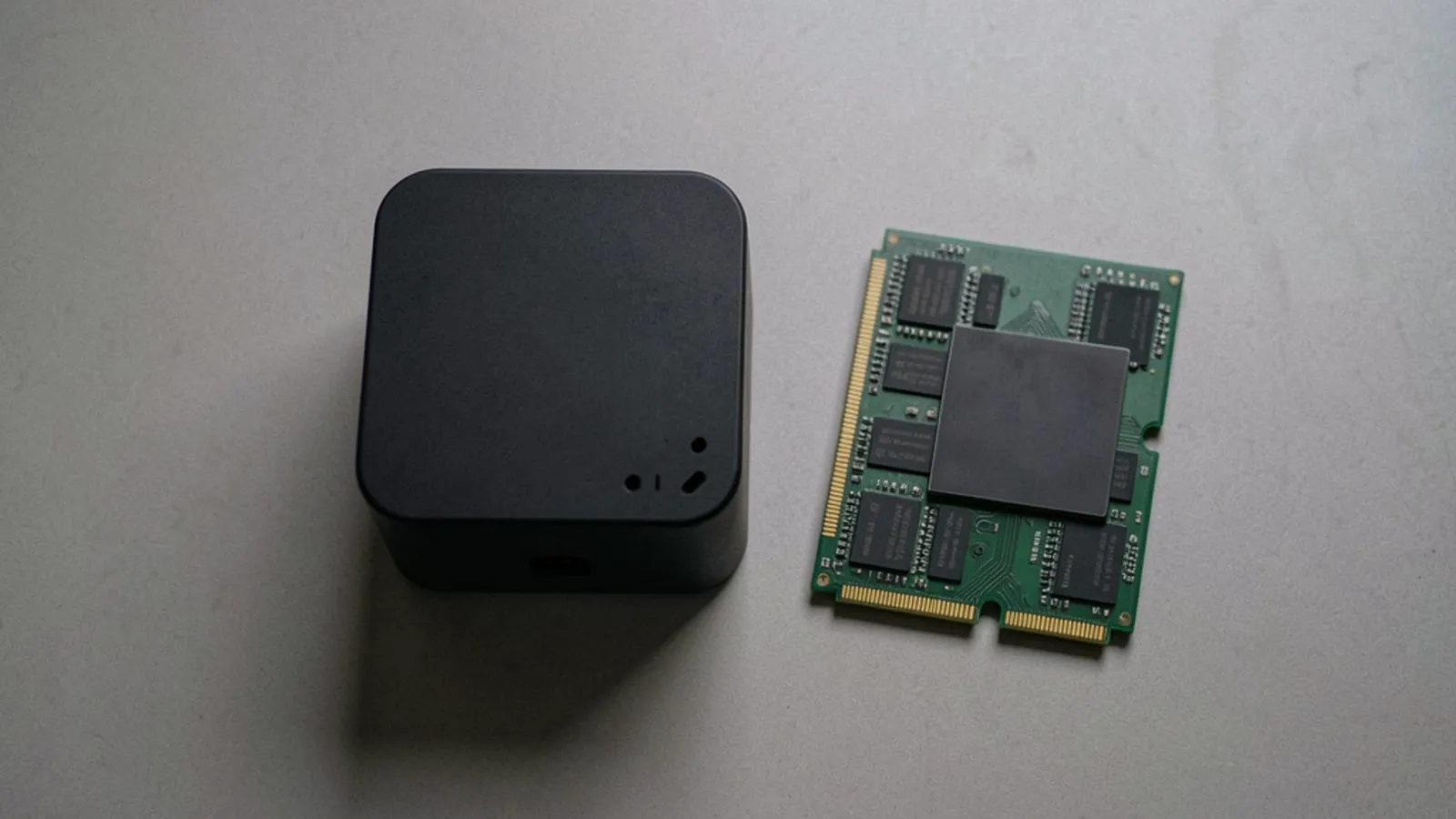
Griffais said the quiet part in the pricing interview. “Our original design, of course, was based on memory and storage prices from two years ago or so, and so we were in a different segment than we were hoping to be, but I think it’s more of a reflection of where the market as a whole is than Steam Machine itself.” Read that as: we designed a $700-ish box and the bill of materials moved out from under us. Valve’s own post put it more coldly, saying the prices “reflect the state of the world for manufacturing; or, more accurately, it reflects the price [of] the components as we’ve secured them over the past 6 months.”
And you can see the same crisis chewing through the rest of Valve’s lineup. On 27 May the Steam Deck OLED went from $549 to $789 for the 512 GB model, and from $649 to $949 for the 1 TB. That is close to a 50% increase on a product that did not change one screw. Valve’s line was blunt: “Steam Deck itself hasn’t changed; these new prices reflect the current state of component costs and other global logistical challenges across the industry as a whole.” Tim Sweeney publicly went after Valve for it. The Deck then sold out in North America again the following day, which tells you something uncomfortable about how much pricing power a beloved product actually has.
| SKU | USD | GBP | EUR |
|---|---|---|---|
| 512 GB | $1,049 | £879 | €1,039 |
| 512 GB + Steam Controller | $1,128 | £938 | €1,108 |
| 2 TB, walnut and red faceplates | $1,349 | £1,149 | €1,359 |
| 2 TB + faceplates + Controller | $1,428 | £1,208 | €1,428 |
The controller bundle uplift is $79 against a $99 standalone price, so if you want one, buy it in the box. That’s the only unambiguous saving in the whole table.
One thing to kill before it spreads, because I’ve seen it repeated: tariffs are not the reason the Steam Machine costs what it costs. No Valve statement ties Machine pricing to import duties. Valve did cite “distribution costs, import duties/tariffs, and marketing conditions” for the regional spread on the Steam Controller, which shipped 4 May at $99 US, and that is the only place tariffs enter the story. Anyone telling you the cube is expensive because of trade policy is filling a gap with a guess.
For context on how far off everyone’s expectations were, PC Gamer’s hardware team was guessing $500 to $600 for a 512 GB model as of November 2025. That’s not a knock on them. That was the sane read of the parts market at the time. The gap between that guess and $1,049 is the whole story of the last nine months in PC hardware.
Taking the anti-subsidy argument seriously, then poking it
I want to give this a fair hearing, because it’s the most substantive thing Valve has said about hardware in years and it deserves better than a shrug.
Griffais, asked whether Valve had ever quietly subsidised the Steam Deck: “Not really. If you look at certain SKUs at certain points of time… it might be below or above cost by a small margin… Same thing here… we’re actually quite a bit more aggressive now, because we understand that the higher price is less accessible to people.” Aldehayyat drew the line more sharply: “It’s important that the Valve hardware is a self-sustained program; it’s not subsidized by software sales.”
That is internally consistent, and it’s not a pose. Valve backs it with behaviour. A SteamOS USB installer for DIY AMD-discrete-GPU builds shipped alongside the machine, which is Valve handing you the operating system for free and telling you to go buy someone else’s box if you’d rather. Valve published the Steam Controller and Puck CAD files under CC BY-NC-SA on 6 May so modders can print their own. It says it will work with iFixit “to make the parts available… all the FPCs, daughter boards, and ports,” with repair manuals. It never bought a launch exclusive, and Valve has said on record that its idea of a “launch exclusive” is “the whole PC catalog.” A company optimising for lock-in does none of that.
A console sold at cost competes against consoles sold below cost. That is the whole problem in one sentence.
And here’s where I get stuck. The principle is about platform health. The purchase decision is about a number. Nobody standing in front of a $1,049 cube feels the ideology, they feel the $1,049, and the boxes it sits next to on the shelf are priced by companies that have decided losing money on hardware is fine because they’ll take it back on a 30% cut and a subscription. Valve gave up the software-funded discount voluntarily. That’s admirable and it’s also unilateral disarmament in the only fight the customer can see.
The steelman for Valve’s side is that the discount is never free. You pay it back in a closed store, a mandatory subscription to play online, and a machine that turns into a paperweight when the servers go. Buy the cube and you get a PC that will boot whatever you install on it in ten years. That’s real value and it’s genuinely hard to price. My honest read is that it’s worth something, just not the full delta, and Valve knows this, which is why Griffais said out loud that they’re being “quite a bit more aggressive” on margin than they were with the Deck.
The tell is what happened when they were asked what they’d change. Aldehayyat: “Make it cheaper.” Griffais: “Yeah, I mean, that’s an easy one.” Nobody at Valve thinks this price is good. They think it’s honest. Those are different claims and I appreciate that they’re not conflating them.
The engineering is the best thing here, and it isn’t close
Strip the price argument away for a minute, because the physical object is lovely and I don’t want that lost in the noise.
The 200 W power supply is internal, and it doubles as the structural chassis. Not bolted to a frame, it is the frame. That’s the kind of decision that only survives a design review if the team has real authority, because it makes every downstream problem harder and it’s invisible on a spec sheet. The whole thing lands at roughly a six-inch cube with a removable faceplate and a front LED light bar, and no external brick to hide behind your TV.
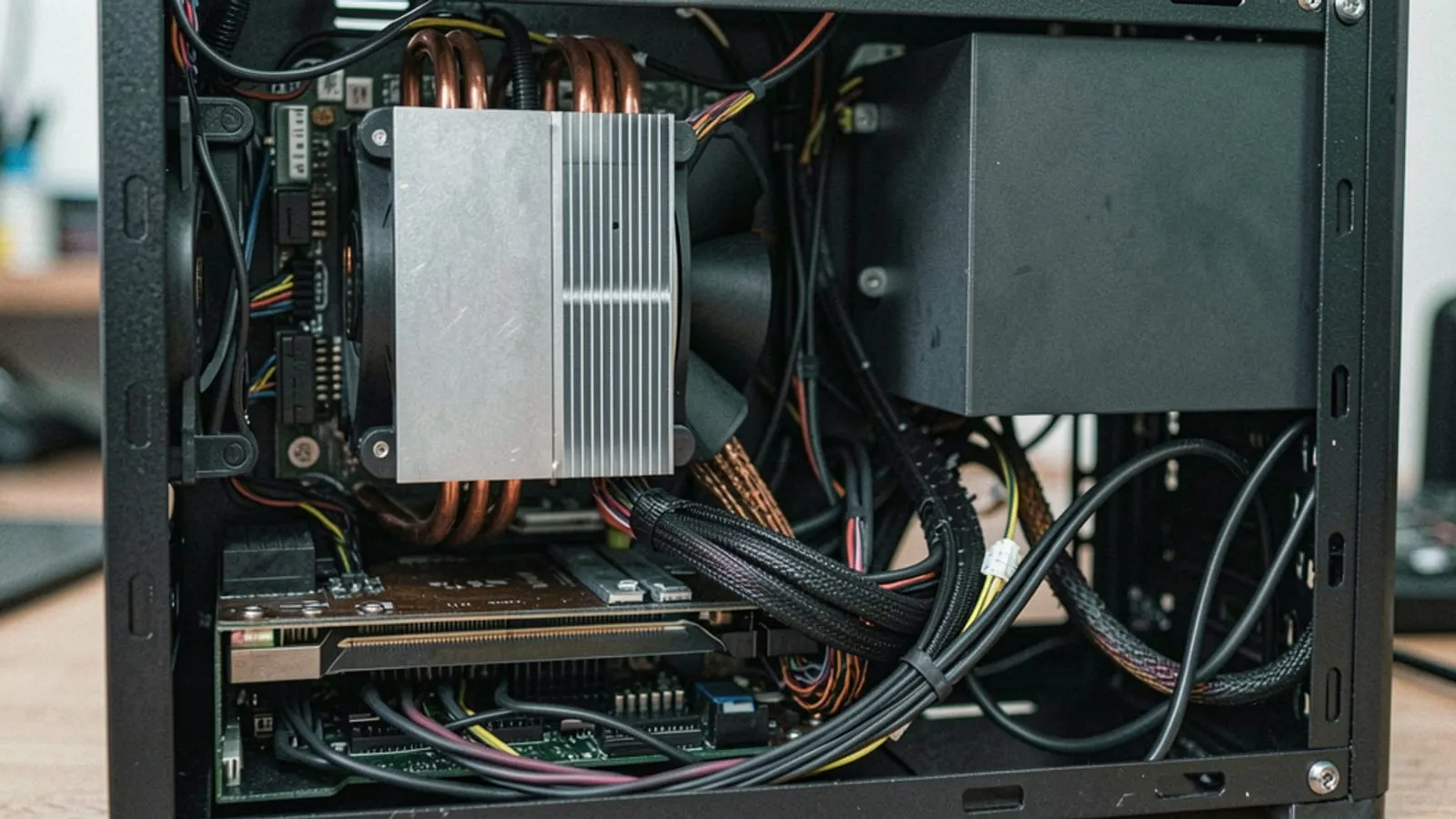
Then there’s the cooling, which is my favourite bit. One custom 120 mm fan. One shared heatsink handling CPU, GPU, memory and VRM together. Aldehayyat explained the reasoning better than I could: with two thermal modules, each has to be sized for its own worst case, but “if you have one, then it can share… if the CPU is not eating up its entire thermal budget, the GPU can use that.” Griffais added the payoff. “It’s also the quietest.” That’s a real insight about game workloads, which almost never max the CPU and GPU simultaneously, turned into less metal and less noise. Console thermal design at its best, in a box you can open.
The wireless work is quietly thoughtful too. Four antennas total: Wi-Fi 6E 2x2, Bluetooth, and a dedicated 2.4 GHz radio that pairs up to four Steam Controllers directly, so the Puck that ships with the standalone controller becomes redundant. Small thing. It means the couch case works out of the box with no dongle sticking out of a front port.
The RAM you can replace but can’t get to
The memory is 16 GB of DDR5 on SO-DIMM, so in principle it’s user-upgradeable. In practice you have to strip the casing and the heatsink to reach it. Aldehayyat didn’t spin this, and I respect him for it. “We tried to make the RAM more accessible, but there was just no real way to… trying to make an access hatch through the power supply just wasn’t possible for safety reasons.”
That is an engineer telling you they lost. The PSU is the chassis, the chassis is in the way, and the elegant decision upstream cost them the convenient one downstream. You can hear the design meeting in that sentence. Storage fared better: it ships as M.2 2230 with an included standoff so a 2280 drive drops in, plus microSD up to 2 TB with cards that move between Deck, Frame and Machine.
Rest of the I/O is fine and slightly dated in one spot. Front gets two USB 3.0-A and the microSD slot. Rear gets two USB 2.0-A, one USB-C 3.2 Gen 2 at 10 Gbps, gigabit Ethernet, DisplayPort 1.4 and HDMI 2.0. HDMI 2.0 in a box being sold to people with 4K televisions is a choice, and combined with what follows it’s a bit of a theme.
About that 4K claim
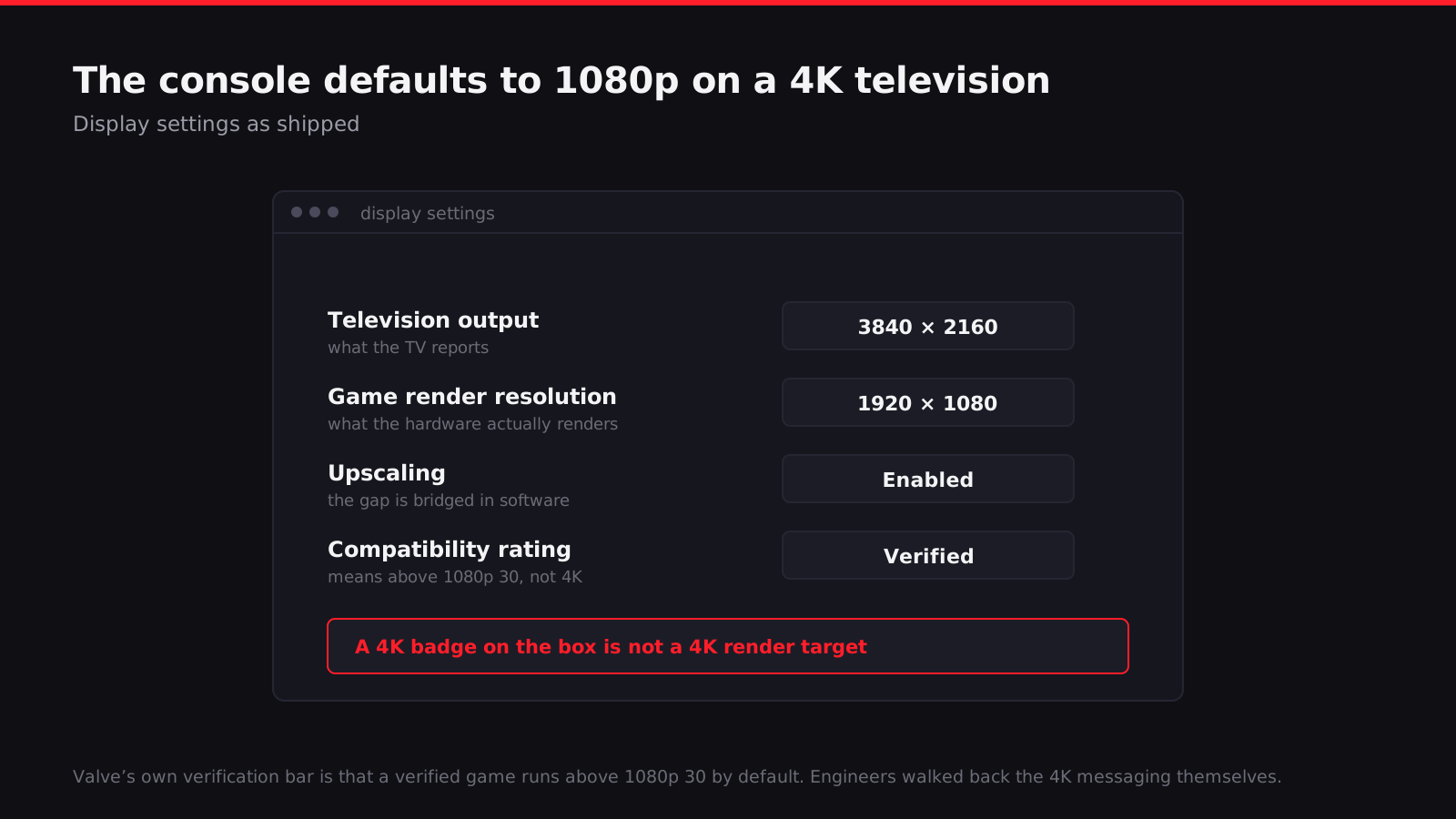
At announcement Valve said the Machine “should have enough performance to play every game on Steam at 4K60 when you do some sort of upscaling like FSR,” and that it’s “over six times faster than a Steam Deck.” The second part is a Deck comparison and I have no reason to doubt it. The first part has been walked back by Valve’s own engineers, and how they did it is instructive.
Aldehayyat: “A big part of that messaging actually came because we found a lot of people who are not as familiar with tuning their gaming settings want to just make sure that it’s compatible with their 4K TV… for a lot of games, rendering a 1080p or 1440p is definitely the sweet spot.” So the 4K talk was about output compatibility, apparently, not render target. I’ll take the explanation at face value while noting that “plays every game at 4K60” is a strange way to say “outputs to your 4K TV.”
The behaviour of the software backs the softer version. SteamOS defaults games to a 1080p render resolution on Steam Machine. And the verification bar is lower than you’d assume from a 4K headline. Griffais, on what Verified actually guarantees: “The only thing that we want to make sure that a verified game gets at is that by default it’s above 1080p 30.” Above 1080p 30. That is the floor, and it is a console-style floor rather than a PC-style one.
8 GB of soldered VRAM is the decision that will hurt
Here’s the spec that made me wince. The GPU is a semi-custom RDNA 3 part, 28 compute units, running somewhere around 2.4 to 2.5 GHz in a roughly 110 to 130 W envelope, and it’s understood to be a Navi 33 derivative. The nearest retail reference point is the Radeon RX 7600M, which also has 28 CUs and a 2.41 GHz boost but only a 90 W budget, so Valve is feeding this thing considerably more power than the mobile part it resembles. Fine. The CPU alongside it is semi-custom Zen 4, six cores and twelve threads, which is plenty for a machine whose job is games.
The problem is the 8 GB of GDDR6 sitting next to it, soldered.
Griffais knows. “We are very aware that… eight gigs is kind of aggressive,” he said, before offering the defence: “The cases where you’re exercising the VRAM limits are actually cases that you wouldn’t want to play as a real user.”
I think that defence is half right and I still think it’s the wrong call. It’s true that a 28 CU GPU will usually run out of shading throughput before it runs out of memory, and that the settings which blow past 8 GB on a machine like this tend to be the ultra texture presets that would tank the frame rate anyway. Griffais is describing real behaviour, not spinning.
But two things break it. First, textures are the one setting that costs VRAM and almost nothing else, so on a memory-starved card you’re forced to give up the cheapest visual upgrade available. Second, and worse, this is a fixed-spec appliance that Valve wants to sit in your living room for years, and the direction of travel on PC memory requirements has been one way for a decade. Tom’s Hardware flagged exactly this in its review, calling the hardware aging and questioning the 8 GB. It is the criticism I’d lead with too. Everything else in this box can be worked around by a patient owner, and 8 GB of soldered memory cannot. You can put a 4 TB drive in it. You can swap the SO-DIMMs if you’re willing to fight the heatsink. The VRAM is what it is until you buy a different machine.
I’d have taken a slightly slower GPU with 12 GB. I suspect at least a few people at Valve would have too, and I suspect the memory market is exactly why they couldn’t.
The lottery Valve got right
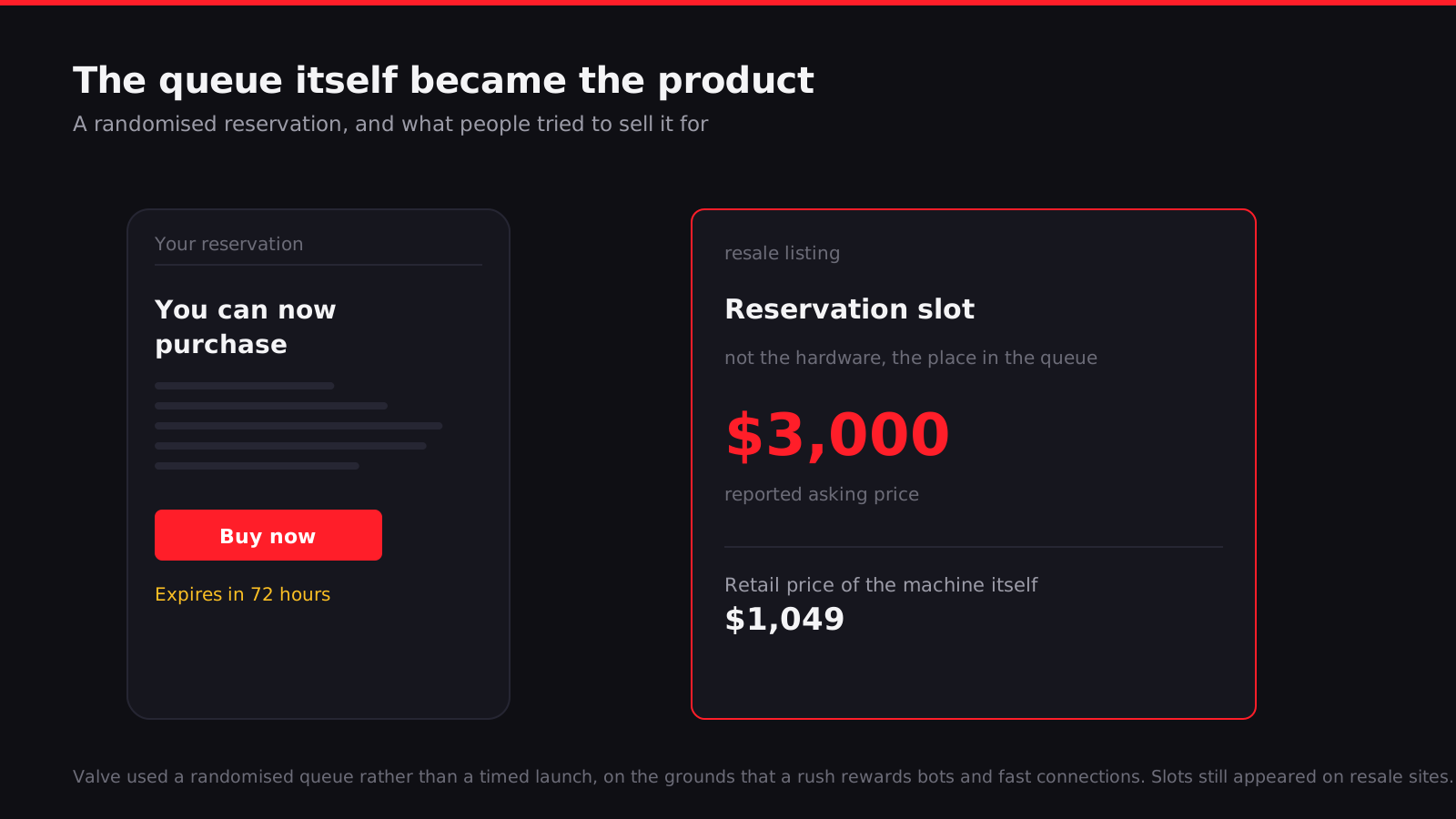
Small thing, worth flagging because it’s rare. Reservations opened 22 June and closed on 25 June at 10am PT. Everyone who entered got randomised into a queue plus a waitlist, per product and per region across North America, the UK, the EU and Australia. You needed a Steam account in good standing with a purchase before 27 April 2026, one entry per household, and winners get 72 hours to actually buy. Purchase emails started the week of 29 June, which is also the release date.
Griffais on why they didn’t just open the doors: “There’s still an effect where people are rushing at the door, trying to refresh. Our websites might have problems… We want to make sure that there’s an even playing field initially.” Valve’s blog was more direct, saying a timed launch “tends to reward bots, people with fast internet connections.”
That’s correct, and I’d like every hardware company to read it twice. The Steam Controller sold out in about half an hour on 4 May, and by 19 June new controller reservations weren’t being fulfilled until 2027. A refresh-race launch for the Machine would have been a bot festival. Reservation slots still turned up on eBay, and Tom’s Hardware reported asks as high as $3,000, so the lottery didn’t kill scalping. It just made scalping unprofitable at scale, which is roughly the best you can hope for.
Supply is the constraint and Valve is candid about the cause. Griffais: “We’re basically building everything we can. We’re limited by memory capacity, for sure.” Aldehayyat in July was bleaker. “Honestly, it’s still getting worse. Just in case people are not aware. What people are seeing on retail shelves right now, from our observations, is lagging what we’re seeing from a bulk supply by at least three to six months.” As of 29 July Valve said it was fulfilling orders daily and expected everyone currently in the reservation queue to get a purchase email by the end of 2026, and that in some products and regions it had already reached the end of the queue and started inviting people off the waitlist.
The software is the actual product
Something the spec arguments tend to miss. What you’re buying at $1,049 is partly a box and partly SteamOS 3.8, which shipped 18 June and is the most consequential release Valve’s operating system has had.
It brought initial Steam Machine support, obviously. It also moved Desktop Mode to Wayland by default with KDE Plasma up to 6.4.3, added external HDR display support and VRR including preliminary HDMI VRR, per-display scale factors, and moved to Linux kernel 6.16. The non-Deck half of the patch notes is the interesting half: better compatibility with recent Intel and AMD platforms, “greatly improved video memory management on discrete GPU platforms,” a chainloader boot fix for newer UEFI firmware, and controller support added or improved across a long list of third-party handhelds from Lenovo, ASUS, MSI, OneXPlayer, GPD and others. Handheld controller input latency dropped from 5 to 8 ms down to the 100 to 500 microsecond range, which is the kind of fix nobody markets and everybody feels.
As of 3.8, Valve officially blesses SteamOS on non-Valve hardware, with a hard caveat: AMD GPUs only. Nvidia support is not shipping as of August 2026, and the 3.8.10 release in June added beta AMD and Intel desktop support with Nvidia promised vaguely “in the future.” Current state is 3.8.16 stable from 16 July with a 3.8.25 beta from 8 August.
There is a decent performance story attached to all this, with one caveat I want to be precise about. PC Gamer measured up to 32% higher performance in Cyberpunk 2077 under SteamOS than Windows 11, but that was on a Lenovo Legion Go S, not on a Steam Machine. Don’t transplant the number. Do note that PC Gamer currently ranks the Legion Go S running SteamOS as its best overall handheld PC for 2026, which says something about how far the OS has come as a product in its own right.
Windows, if you want it, is a grudging yes. Griffais on drivers: “That’s our goal. Right now, we’re still working on certain drivers, you know, around Bluetooth… we’ve been talking to AMD about the best way for users to get the graphics drivers.” Aldehayyat compared it to the Deck’s driver situation and said it would take time after launch. Valve has since put drivers and notes out, and it refuses to support Windows on the machine. Dual boot is not a shipping feature either. Griffais: “We don’t have dual boot, an easy dual boot wizard plumbed right now. There’s a few ways that you go about it, but right now, most of them include some manual steps where you repartition your disks and resize stuff by hand.” So if your plan involves Game Pass on the couch, understand that you’re the support department.
Who is this actually for
The critical response landed in a shape that’s easy to summarise and hard to argue with. PC Gamer gave it 62%. As rounded up by PCGamesN, IGN went 8/10 and called it the easiest way to get into PC gaming, The Verge went 6/10, Tom’s Hardware found the pricing competitive but the hardware aging, Eurogamer said it would be a genuine competitor if it were cheaper, and Linus Tech Tips called it the best solution to PC gaming on the couch while noting the power ceiling. Well-made, pricey, niche. Everyone landed within a hair of the same verdict from different directions, which usually means the product is legible and the price is the argument.
Unit sales are unknown. Valve declined to give Bloomberg any figures, and Aldehayyat reframed success without numbers at all: “We suspect that the Steam Machine is a really good way to solve a very real problem that people have. If that’s borne out to be true, from our opinion, it’s a success.” Convenient framing for a company that doesn’t publish sales, sure. Also probably the honest internal metric for a hardware program that isn’t allowed to lose money.
Here’s who I think should buy one. Someone who already knows they want a small quiet PC under the TV, who has a Steam library worth four figures, who is fine at 1080p or 1440p with FSR, and who values a machine that boots whatever they tell it to over a machine that boots what a platform holder permits. For that person the cube is close to ideal and the price is annoying rather than disqualifying. That’s a real person. I know several.
Everyone else is being asked to pay a premium for a philosophy they don’t get to spend. And I keep thinking about the 2015 Steam Machines, which failed for the opposite reason: they were badly conceived boxes at bad prices running an OS that couldn’t run the games. This one is a well conceived box at a bad price running an OS that genuinely works. That’s progress of a strange kind. Valve fixed the hard problem, which was software, and then got mugged by DRAM contracts on the easy one.
Griffais also drew a distinction I think is underrated. He doesn’t view the Machine on Deck timescales. “I don’t think we’re thinking about [the Steam Machine] with quite as long of a timeframe as something like the Steam Deck… the Steam Deck, by its nature, needs a little bit more of a fixed performance target… whereas the Steam Machine is very much in line with gaming PCs.” He also said there are no immediate plans for a different performance target. Read together, that sounds like a product Valve is willing to revise when the parts market lets it, without promising anything.
Verdict
Valve Steam Machine (512 GB)
What lands
- Genuinely clever engineering: internal 200 W PSU doubling as the chassis, one shared heatsink across CPU, GPU, memory and VRM, and a single 120 mm fan
- SteamOS 3.8 is the real product, with Wayland desktop, HDR, VRR and a DIY installer for AMD builds
- Dedicated 2.4 GHz radio pairs up to four Steam Controllers with no dongle
- Valve refuses to subsidise or buy exclusives, and backs the openness talk with iFixit parts, repair manuals and a free OS installer
- The reservation lottery beat a refresh-race launch and Valve said exactly why
What does not
- $1,049 for a 28 CU RDNA 3 part is a hard sell, and every reviewer said so
- 8 GB of soldered GDDR6 in 2026 is the one flaw an owner cannot work around
- The 4K60 messaging oversold it, and SteamOS defaulting to 1080p tells the truer story
- SO-DIMM slots you have to remove the heatsink to reach, which Valve admits it failed to solve
- No dual-boot wizard, and Windows works but is unsupported
The best-engineered small PC Valve has made, priced by a memory crisis nobody at Valve is happy about. Worth it if you specifically want an open couch PC and can live at 1080p or 1440p. Hard to recommend to anyone shopping on price.
What would change my mind is a price cut, and Griffais has already put that on the table without promising it. So the real question isn’t whether this cube is worth $1,049 in August 2026. It’s what happens the first quarter DRAM contracts loosen and Valve has to decide whether the anti-subsidy principle also means passing savings down as fast as it passed costs up. That’s the test. I think they’ll take it, mostly because Aldehayyat’s answer to what he’d change was two words long.
Read next
Unreal Engine 5 Stutter Isn't One Problem, It's At Least Three
Shader compilation, traversal streaming and expensive rendering features all cause stutter in Unreal Engine 5 games, but they have different causes, fixes and levels of developer blame.
Average FPS Is the Least Useful Number in Any Benchmark Chart
A practical guide to reading frame-time graphs, percentiles and latency so a benchmark chart tells you something true instead of something flattering.
The bugs don't sink a broken launch. The apology does.
S.T.A.L.K.E.R. 2 shipped broken and became Game of the Year. Borderlands 4 shipped broken and lost its opening week. The difference was never the bug list.