
The bugs don't sink a broken launch. The apology does.
S.T.A.L.K.E.R. 2 shipped broken and became Game of the Year. Borderlands 4 shipped broken and lost its opening week. The difference was never the bug list.
Two studios shipped broken PC games within about ten months of each other. One studio’s founder told a player with a five-figure PC budget to expect disappointment, because they were, in his words, trying to drive “a monster truck with a leaf blower’s motor.” The other studio’s director said his team was so exhausted after fourteen years of development, crunch, and relocating out of a warzone that asking for one more delay would have killed them. Take a guess which game finished its year at 84% positive with a Game of the Year award, and which one lost its opening sales window explaining itself on social media.
I’ve spent the last few weeks going back through every major broken PC launch of the past two years, and a pattern kept showing up that had nothing to do with how bad the bugs actually were. Borderlands 4 crashed less than S.T.A.L.K.E.R. 2 did on release day. It really did. But one game clawed its way from Mostly Negative to Mixed and stayed there, and the other went from launch chaos to 84% positive and a critics’ award. The technical severity wasn’t the variable that mattered. What mattered was what the studio said out loud in the first two weeks.
That’s the whole argument of this piece, and I’m going to walk you through the evidence for it launch by launch, because it holds up disturbingly well once you line the cases up side by side.
When the studio says sorry first
S.T.A.L.K.E.R. 2 came out on 20 November 2024 after fourteen years of development, most of it under conditions nobody should have to make a video game in. GSC Game World is a Ukrainian studio. Development continued through the Russian invasion, through relocation, through the kind of pressure that doesn’t show up in a Metacritic score. Studio head Ievgen Grygorovych put it plainly when asked why they didn’t just delay again: “You’re so tired that you would just die if you say let’s run an additional marathon.” Creative director Mariia Grygorovych framed it differently but landed in the same place: “It’s a game with soul, with feelings there, with love there.” They shipped anyway, missing budget on polish, because another delay would have broken people who were already running on nothing.
And it showed. PC Gamer’s own review, while scoring the game 83%, described “innumerable pre-day-one-patch bugs” including weapon audio cutting out and dead enemies becoming, in the reviewer’s memorable phrase, “beautiful distended masses of flesh.” This wasn’t a clean launch that got unlucky. This was a genuinely rough one.
Here’s the part that actually matters for the argument, though. GSC didn’t spend launch week explaining why the bugs were your fault. It spent launch week fixing them, in public, at a pace that’s honestly a little absurd to lay out:
- 29 November 2024, nine days after launch: first major patch, 650+ individual fixes, monster balance nerfs, memory leak patches, crash fixes.
- 30 November: a second patch addressing progression blockers.
- 3 December: a third patch.
- 19 December: a 110 GB Christmas patch that revived the A-Life system, the AI simulation that’s core to what a S.T.A.L.K.E.R. game is supposed to feel like and that had shipped functionally broken.
- 15 February 2025: another wave, 1,700+ fixes.
- 18 March 2025: Patch 1.3, over 1,200 changes including close to 100 crash fixes, further A-Life repair, rebalancing, memory leak work, texture stretching fixes, and the closure of a permanent artifact-stacking exploit.
GSC called this “just the beginning of a long journey of support,” and it wasn’t marketing copy. Patch 1.5 landed in June 2025, 1.6 in September, a story expansion called Stories Untold in December. That’s over a year of continuous, substantial patching for a game that had already shipped.
The commercial numbers back up the strategy. Over a million copies sold within 48 hours of launch, with GSC saying at the time “this is just the start.” By 4 December 2024 the game sat at 84% positive across more than 62,000 Steam reviews. By 5 March 2025, GSC reported six million players in three months, a figure that’s likely inflated by Game Pass access rather than pure sales, but a huge number regardless. PC Gamer gave it Game of the Year.
None of that happened because the bugs were minor. It happened because GSC never once suggested the bugs were your fault for owning the wrong hardware.
Crimson Desert: the anti-Borderlands 4
If you want a second data point that isn’t a fourteen-year passion project made under wartime conditions, look at Crimson Desert. Pearl Abyss launched it on 19 and 20 March 2026 to around 239,000 concurrent Steam players and Mixed reviews, and a decent chunk of the complaints were about design rather than raw performance. “Want to talk to an NPC? You need to press multiple buttons,” one player wrote. “Puzzles are literal atrocities,” said another. Fair criticisms, honestly.
But the real fire was hardware-specific and ugly. On day one, the game would not boot at all on Intel Arc GPUs. Not “ran badly.” Would not start. Players on Arc cards were being told to just refund it. It stayed only “somewhat playable” on Arc by 9 April, three weeks later. Some Deluxe and preorder buyers couldn’t access their bonus items on day one either. Ray Reconstruction and lighting options were still broken as of 31 March, and upscaling problems persisted past 23 April.
That’s a genuinely bad launch. An entire GPU vendor’s worth of customers couldn’t play the game at all.
And yet Pearl Abyss announced 2 million copies sold within 24 hours, then 4 million by 1 April, then 5 million within the first month. It hit those numbers while still patching around basic boot failures on a major GPU brand, because the company’s public posture the whole time was “we’re going to work to make improvements quickly,” not “your hardware wasn’t premium enough.” Aggressive, unglamorous, constant patching turned a launch that should have been a disaster into a commercial success story. It’s basically the mirror image of what Gearbox did with Borderlands 4, and it’s worth sitting with how different the outcomes were for launches with comparably severe technical failures.
“Premium game made for premium gamers”
Okay. Let’s do Borderlands 4 properly, because it’s the case that makes everyone in this argument the angriest, and it deserves the full escalation, not a summary.
Gearbox launched the game on 11 September 2025 into a genuinely strong opening, 192,000-plus concurrent players. And it landed at Mostly Negative on Steam anyway, almost entirely over performance and crashes. The user reports weren’t vague grumbling either. An RX 6900 XT owner: “Turned it down to Low graphics presets and couldn’t hit 60 FPS, even with FSR upscaling.” A 3080 Ti owner: “30fps at native medium to high settings on 1440p with a 3080 TI. It also looks worse than BL3.” That last line stings a bit if you’ve seen the game. It’s a cel-shaded title. It should not need a monster GPU to look the way it looks.
And this wasn’t a budget-hardware problem. An RTX 5090 paired with a Ryzen 7 9800X3D, arguably the best consumer gaming rig money could buy at the time, struggled to clear 120 fps at 4K. Meanwhile the actual mainstream Steam hardware, RTX 3060s and 4060s, couldn’t hold 60 fps at 1080p on medium settings. The community’s summary of Gearbox and Nvidia’s own optimized-settings guide was blunt: “Even with a 9800X3D and a 5090 it runs like absolute buttcheeks.”
Gearbox shipped a 2.7 GB day-one patch that reduced crash frequency, though it arrived after launch rather than before it, and reviews did eventually climb back to Mixed. But the story of the next two weeks wasn’t the patch. It was Randy Pitchford.
The escalation
Pre-launch, on 8 September, Pitchford said the day-one patch “does a lot” but that players should keep “realistic” expectations, adding that “older hardware may not provide buttery smooth performance.” Fine, mostly. Standard pre-launch hedging.
Then, on 15 September, four days after launch, with the game sitting at 65% Mixed: “Borderlands 4 is a premium game made for premium gamers.” He said the game “cannot be expected to run on too-old PC hardware,” and then the line that turned into the whole story: “if you’re trying to drive a monster truck with a leaf blower’s motor, you’re going to be disappointed.” He suggested 4K owners just drop to 1440p, and told players on what he considered unsuitable systems to take a Steam refund.
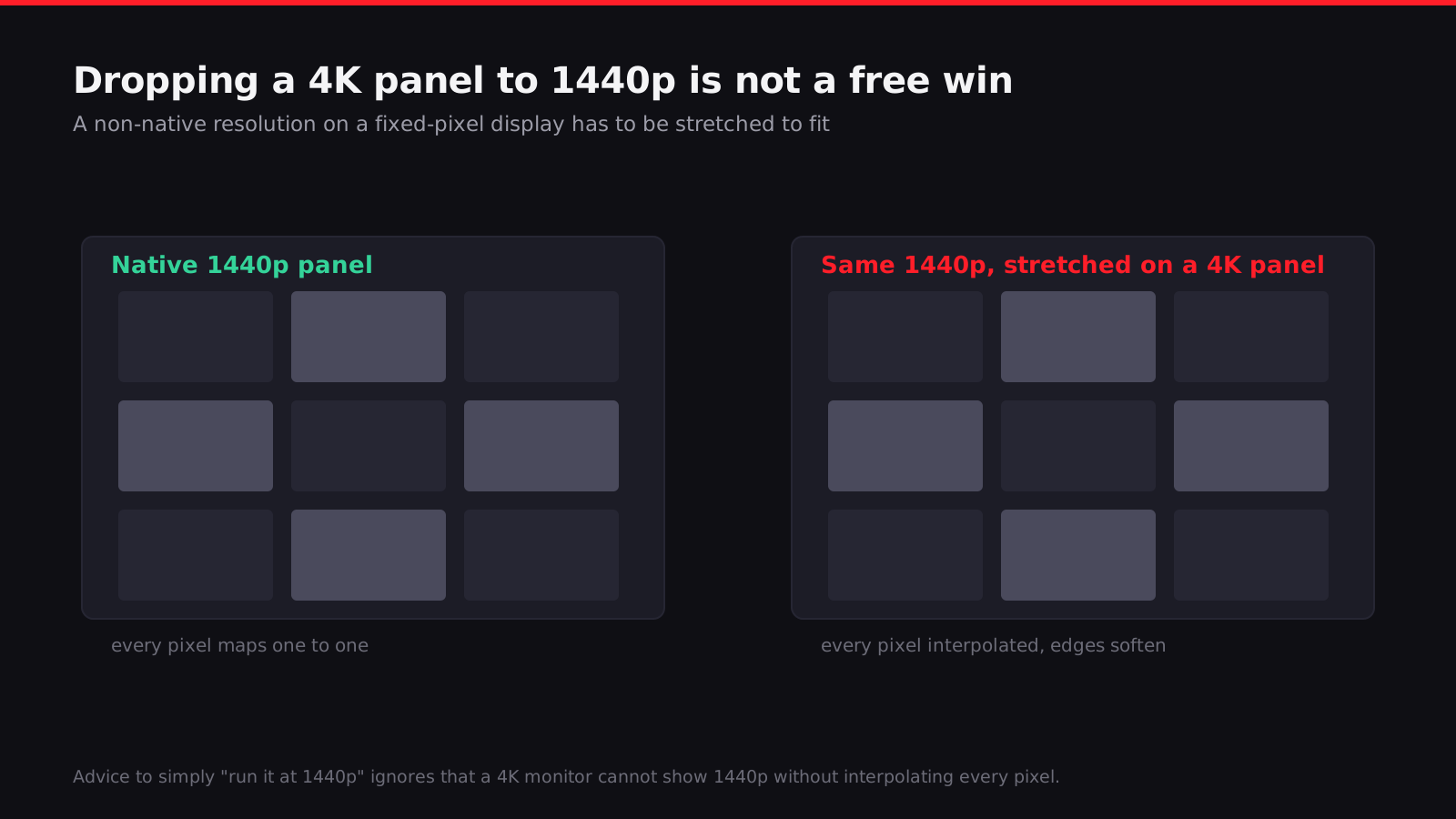
PC Gamer’s response is worth quoting directly because it’s the sharpest rebuttal in this entire genre of story: the game is cel-shaded, it looks like something a decade old, and it was demanding cutting-edge hardware to run it. And downscaling a 4K monitor to 1440p doesn’t give you a clean 1440p image. It gives you a blurry, stretched one. Telling players to do that as a fix isn’t advice. It’s a workaround dressed up as a solution.
Then, that same day, Pitchford went further and reached for statistics: only 0.04% of customers had filed performance-related support tickets, and only 0.009% of those were judged valid. “Less than one percent of one percent,” as he put it.
This is the single best point in the entire research brief I worked from, and it’s worth slowing down for. Players who hit bad performance don’t file a support ticket. They leave a negative Steam review and move on. A support-ticket rate measures how many people were frustrated enough to fill out a form. It says nothing about how many people were frustrated enough to just refund the game, or write “unplayable” in a review, or tell three friends not to buy it. Citing a 0.04% ticket rate against a game sitting at Mixed reviews from tens of thousands of players isn’t a defense. It’s a category error dressed up as data. PC Gamer’s own conclusion was that the studio “would be well-served if it hired a guy specifically to follow Pitchford around and stop him from tweeting.” I don’t think that’s an exaggeration.
The commercial number is genuinely disputed, so I’ll give you both sides
This is where I have to be careful, because the two data points on the market don’t agree, and I’d rather show you the disagreement than pretend it’s settled. Take-Two CEO Strauss Zelnick told investors on 7 November 2025 that “the numbers were a little softer than we would have liked,” attributing it to PC performance, though he expected a long sales tail. Against that, an analyst read from 23 October 2025 had Borderlands 4 as the top-selling US game of September, the fastest-selling entry in the franchise’s history, and already the third most-bought game of 2025 at that point.
Both of those can be true at once. A game can set a franchise sales record and still land below what a publisher’s internal forecast expected, especially a forecast built assuming a clean PC launch. I’d lean toward reading it that way. Record series sales that still undershot the number on someone’s spreadsheet in Take-Two’s finance department isn’t a contradiction. It’s just two different baselines talking past each other.
Cities: Skylines II bet on tech that wasn’t ready, and eventually admitted it
Cities: Skylines II launched on 24 October 2023 already knowing it had missed its own 30 fps performance target. Colossal Order said so at the time, more or less shrugging it off: “While some setups on PC have challenges, we concluded the performance is not a dealbreaker for all the players.” The official advice for players stuck at low framerates was to turn off global illumination and drop to 1080p. Reviews settled at Mixed.
A year later, Paradox’s deputy CEO Mattias Lilja was honest about it in a way I actually respect: “The lesson learned is that we should probably not launch that early.” He was clear that publisher pressure wasn’t the cause, that the launch date was a joint call, and he was dismissive of the idea that early access would’ve fixed anything: “A dev team that thinks they’re going to have a nicer ride on an early access game, I think fool themselves.”
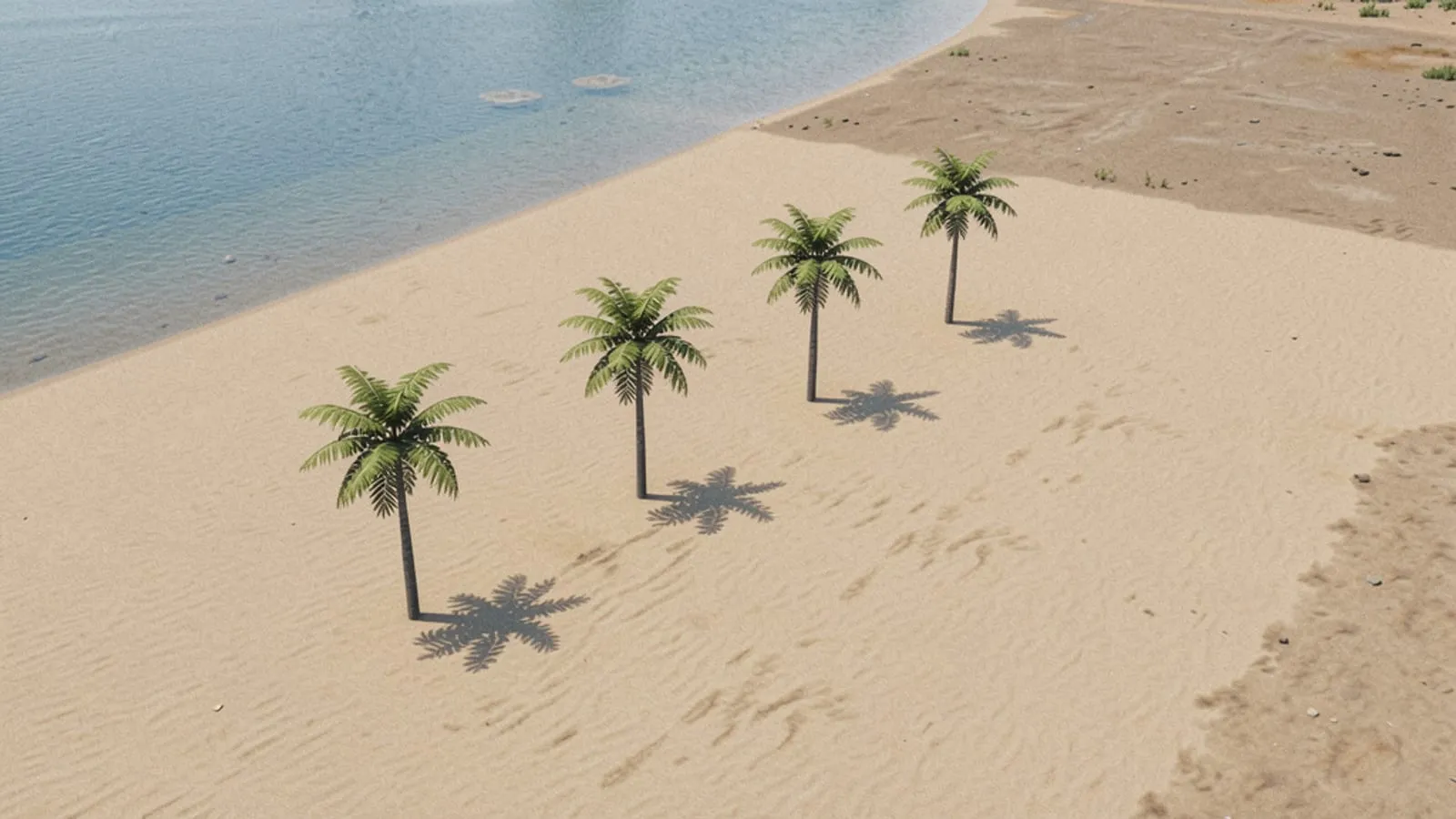
Then came Beach Properties, released 25 March 2024, and this is the low point of the whole saga. A paid DLC so thin it drew apologies and refunds. It landed at Overwhelmingly Negative across more than 1,300 Steam reviews. One review summed it up better than I could: “Four palm trees. 10 sets of houses. No beaches or tools to make beaches.” Colossal Order and Paradox’s joint statement was uncomfortably candid: it “should not have been published in its current form,” and “we thought we could make up for the game’s shortcomings in an unrealistic timeframe, and rushed out a DLC that should not have been published.” They made Beach Properties free, offered refunds, and gave Ultimate Edition owners, for whom partial refunds were impractical, $39.99 worth of creator packs and radio stations instead.
The honest admission came later still, on 18 March 2026, when Colossal Order CEO Mariina Hallikainen finally named the root cause out loud: the studio bet on unfinished Unity engine features. “We completely overestimated the engine’s capabilities,” she said, and “we basically looked into the very new technology that Unity was offering, and that turned out to be a mistake.” She named specifics, which I appreciate because it makes the admission verifiable rather than vague: general engine instability, an HDRP shader pipeline missing core interpolator features, and an Entity Component System that lacked long-running job support. The team had to build replacements for features it had originally planned its entire production schedule around.
Credit where it’s due. That’s a specific, technical, honest postmortem, not a vague “mistakes were made.” It’s just about eighteen months too late. Paradox and Colossal Order parted ways on 17 November 2025, with development moving to Iceflake Studios. The blame-the-engine posture didn’t kill the relationship on its own, probably, but it didn’t help, and the timeline speaks for itself: launch controversy in October 2023, DLC disaster in March 2024, honest admission in March 2026, studio split eight months before that admission even happened. The apology arrived after the divorce, not before it.
MindsEye blamed “bot farms.” Its own publisher wouldn’t say it with a straight face.
If Gearbox’s blame-the-customer posture is the cautionary tale, MindsEye is the extreme version, and it’s a genuinely sad story by the end.
Before the game even launched on 10 June 2025, Build a Rocket Boy co-CEO Mark Gerhard was already telling people that “bot farms” were running “a concerted effort to trash the game.” That’s a remarkable thing to say about a game nobody outside a beta had played yet. And here’s the detail that makes it worse: IO Interactive, the publisher, refused to back the claim. CEO Hakan Abrak said flatly, “I don’t believe that. I just think the game should speak for itself on June 10.” When your own publisher won’t co-sign your excuse before launch day has even happened, that’s not a good sign.
One week before release, the studio’s CFO and Chief Legal Officer both resigned. The game launched to Mostly Negative. A hotfix was promised within days. Founder Leslie Benzies blamed “saboteurs.”
What followed was a cascade. Layoffs immediately after release, more layoffs in May 2026. Laid-off staff pushed back hard on the sabotage story, alleging “systemic mistreatment, mismanagement” and “months of crunch” that they said caused “horrific mental and physical illnesses,” and some have taken legal action against the studio. IO Interactive’s CEO said by September 2025 he was hesitant to ever publish another outside studio’s game again, and the publishing deal was officially dead by 17 March 2026, which also killed a planned Hitman crossover. Star Alexandria Riley said the backlash was bad enough that she thought, “I might never work in another game again.”
As of 4 February 2026, the game was down to 17 concurrent Steam players, with a 24-hour peak of 31. Recent reviews had actually turned “very positive,” probably from the handful of people still playing, but that’s cold comfort against an overall rating still stuck at Mixed and a player count you could fit in a small conference room. Its first big update, “Blacklist,” arrived in April 2026, and was pitched, remarkably, as a way to “share some of the evidence of the sabotage.” I couldn’t verify any refund program tied to the launch, so I won’t claim one exists.
There’s a version of this story where a studio ships broken, gets defensive for a week, and then quietly pivots to fixing things. MindsEye never made that pivot. It kept doubling down on an explanation its own publisher wouldn’t touch, and the game died in front of everyone.
The mechanism underneath most of this: shader compilation stutter
It’s worth stepping back from the drama for a second and talking about what actually breaks on the technical side, because “shader compilation stutter” comes up constantly in this research and most players have never had it explained to them.
Modern PC games compile shader programs the first time a given visual effect is rendered on your specific hardware. If a game doesn’t precompile and cache those shaders properly ahead of time, you get a hitch, a stutter, every single time you encounter something new, a new particle effect, a new material, a new lighting condition. That’s the stutter people describe as a game feeling “janky” even on hardware that should handle it fine. It’s not a raw horsepower problem. It’s a software problem, and it’s exactly the kind of thing a 100 GB manual shader cache workaround is trying to paper over in Borderlands 4. When a player has to manually expand their shader cache to make a game stop hitching, that’s the game telling you its precompilation step didn’t do its job.
Marvel Tōkon: Fighting Souls is maybe the cleanest example of a studio actually tracking a technical root cause all the way down instead of just patching symptoms. Arc System Works saw performance problems during the open beta and said, reasonably, “To our PC players, message received. The team is already hard at work on the performance you deserve, with improvements lined up for day one.” The beta had high CPU usage, stuttering, unnecessary shader compilation, streaming software breaking, and rollback netcode issues, despite peaking at 33,233 concurrent players, more than Street Fighter 6’s beta ever hit.
It shipped broken anyway. Mixed rating, 56% negative across roughly 1,600 reviews at launch, concurrents down to around 10,000. “45 fps on the game, where they get significantly more on Tekken and Street Fighter,” one player wrote. Another: the netcode and performance issues together made “online play very bad, with rollback spikes.” The game also required PSN login, restricting availability in over a hundred countries, an echo of the exact controversy that hit Helldivers 2 in 2024. And it locked out Linux entirely via kernel-level anti-cheat, which is a little ironic given Arc’s own Dragon Ball FighterZ runs fine on Linux with the same anti-cheat software.
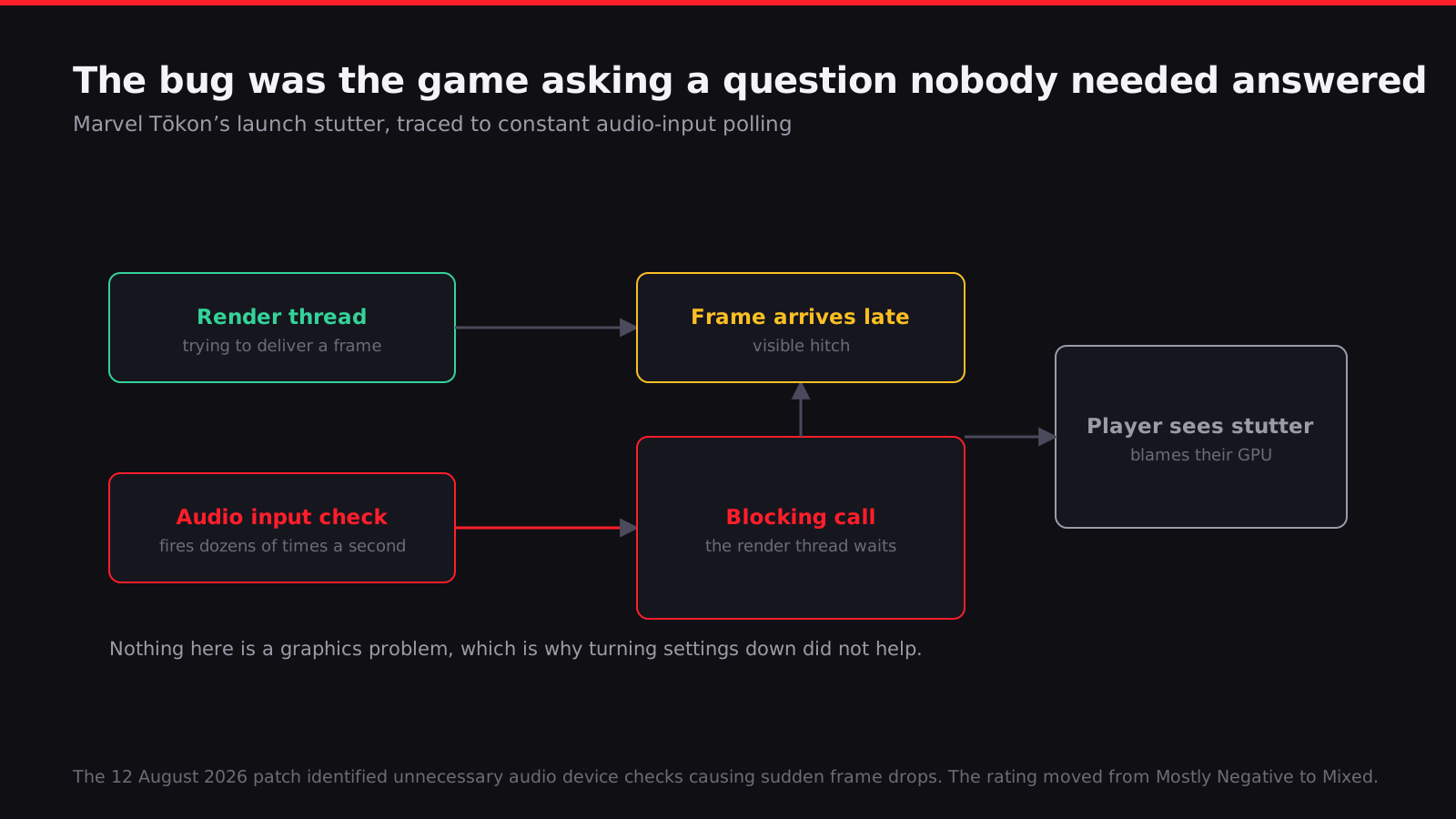
But here’s the part I find genuinely interesting. The 12 August 2026 patch found the actual culprit, and it wasn’t what you’d guess. The game was constantly polling audio inputs in the background, for no functional reason anyone could identify as necessary. Arc’s own patch notes said “these unnecessary checks could cause sudden frame drops and performance drops.” Fixing an audio-polling bug lifted the game from Mostly Negative to Mixed. Not a GPU issue. Not a CPU bottleneck from bad graphics settings. A background process checking your microphone or headset state way more often than it needed to, quietly eating frame time the whole session.
That’s the thing about a lot of these launches. The root cause is rarely dramatic. It’s a caching step that didn’t run, a background loop that never needed to exist, an engine feature the studio built its whole production plan around before it was actually finished. The drama is entirely in how the studio responds once players find it.
Comparing the launches
| Game | What broke | Who they blamed | Outcome |
|---|---|---|---|
| S.T.A.L.K.E.R. 2 | Crashes, memory leaks, broken A-Life, weapon audio bugs | Themselves, explicitly and repeatedly | 84% positive, Game of the Year |
| Crimson Desert | Wouldn’t boot at all on Intel Arc, broken lighting and upscaling | Nobody, just kept patching | 5 million sales in a month |
| Marvel Tōkon: Fighting Souls | Stutter, netcode, an audio-polling bug eating frame time | Nobody, traced the root cause and fixed it | Mostly Negative to Mixed |
| Borderlands 4 | Shader stutter, crashes, unplayable framerates on strong hardware | Players’ “too-old” PCs | Mixed, commercially disputed |
| Cities: Skylines II | Missed performance target, then a near-empty DLC | The Unity engine (admitted 18 months later) | Studio and publisher parted ways |
| MindsEye | Broken launch, near-total collapse | “Bot farms” and “saboteurs” | 17 concurrent players |
Look at that table long enough and the pattern gets uncomfortable. It’s not sorted by how bad the technical problems were. It’s sorted, almost perfectly, by whether the first public statement pointed inward or outward.
Monster Hunter Wilds shows the goodwill doesn’t last forever either
I don’t want to leave you with the impression that saying sorry is a permanent inoculation, because Monster Hunter Wilds complicates the story in a useful way. It launched on 28 February 2025 to complaints that it “runs awful, it looks awful,” record concurrent players undercut by an early Mixed rating, and a Steam Deck that couldn’t hold 30 fps even at its lowest settings. Capcom didn’t do a Pitchford. It didn’t blame anyone’s hardware. It committed to a “multifaceted plan,” which is corporate-speak but at least pointed at itself.
And yet the game got worse over time, not better. After the Final Fantasy XIV crossover update on 29 September 2025, roughly 5,000 recent reviews came in nearly 80% negative, dragging the overall rating back toward Mixed, a full eight months after launch. A player on a 4090 and 7950X3D, about as strong a rig as exists, wrote: “Every time the game gets updated my performance decreases… still crashing frequently.” Another summed it up as well as anyone could: “The game is fun but completely overshadowed by the technical issues, which have been here since day one.” The complaints reached Capcom’s shareholder meetings by July 2025.
So the rule isn’t “apologize once and you’re safe forever.” It’s closer to: an honest first response buys you the benefit of the doubt, and then every subsequent update either spends that goodwill down or reinforces it. Capcom kept talking the right way and still let the technical problems drag on long enough to burn through the credit it had earned.
That, I think, is the real lesson sitting underneath all of this. A day-one patch used to mean something urgent, a studio racing to fix what slipped through before the world saw it at scale. Now it’s mostly a scheduling tool, a number attached to a Tuesday, something a publisher’s PR calendar already knew about six weeks before launch. The patch notes don’t tell you much anymore. What tells you something is the first thing the studio says once the reviews start coming in, and whether it sounds like a team that’s embarrassed or a team that’s already drafting the excuse.
Read next
Unreal Engine 5 Stutter Isn't One Problem, It's At Least Three
Shader compilation, traversal streaming and expensive rendering features all cause stutter in Unreal Engine 5 games, but they have different causes, fixes and levels of developer blame.
The Steam Machine is the most principled console you probably shouldn't buy
Valve's six-inch cube costs $1,049 because Valve refuses to sell hardware below cost. Here is whether that principle, and the engineering behind it, justifies the money.
Average FPS Is the Least Useful Number in Any Benchmark Chart
A practical guide to reading frame-time graphs, percentiles and latency so a benchmark chart tells you something true instead of something flattering.