
The Steam User Review Replaced the Professional Review, and It's a Mess
Paid early access, launch-day embargoes, and missing review code have pushed professional criticism out of the purchase decision, leaving Steam's flawed user review system to do the job instead.
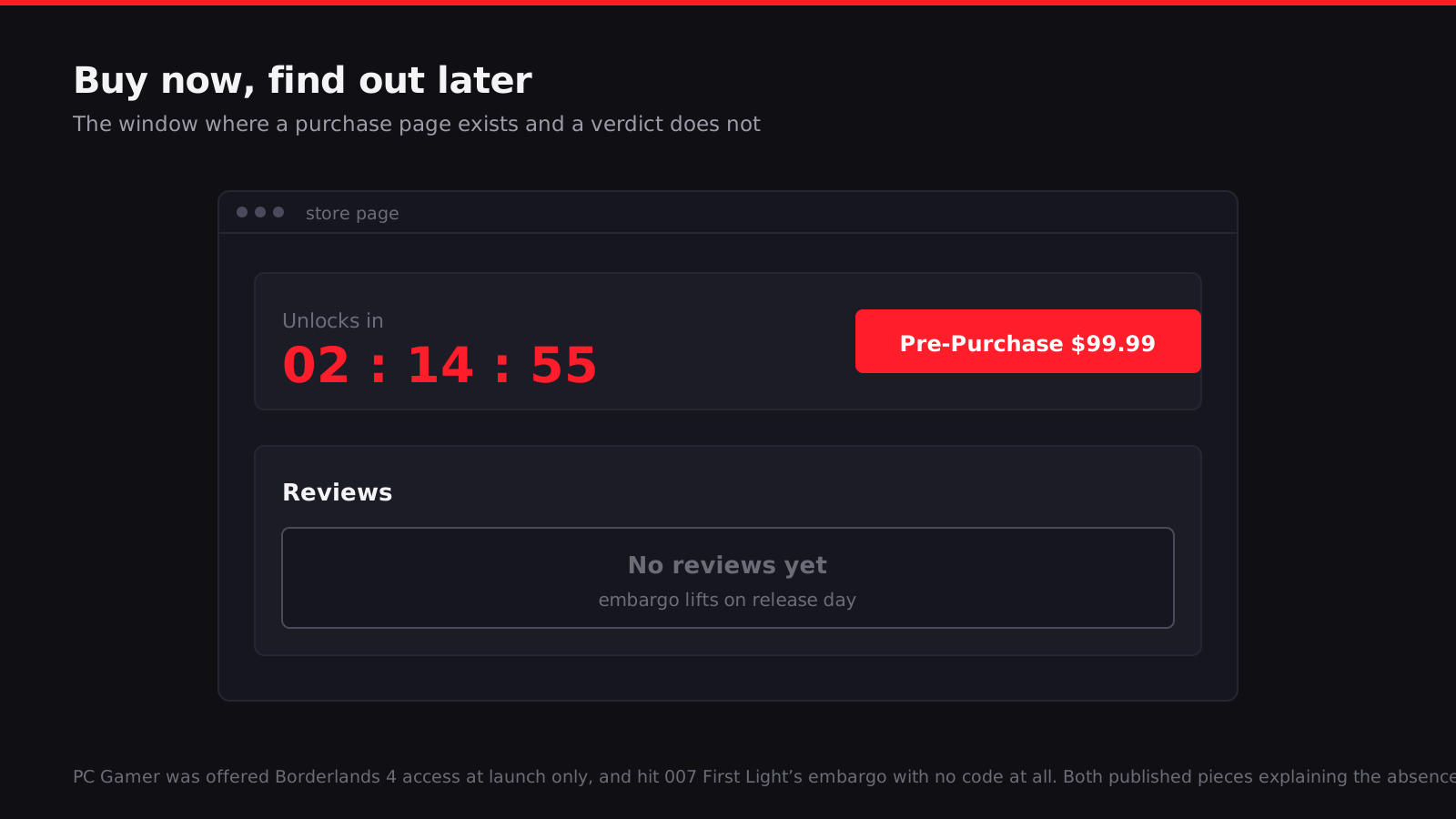
Tyler Wilde said it plainly when Borderlands 4 launched. 2K sent review code to a bunch of outlets, and PC Gamer was “offered access at launch only.” No early build, no chance to test it before the public did, on a PC release with an unusual eight-core CPU minimum that PC Gamer specifically wanted time to dig into. Nine months later, Joshua Wolens was writing almost the same story for 007 First Light, admitting the outlet had “not actually received the, ah, requisite code to do that” as the embargo lifted around him.
Two outlets, two publishers, same result. The professional reviewer ends up writing a piece explaining why there’s no review, instead of the review itself. That’s a new little genre and I don’t love that it exists.
It isn’t an accident of scheduling either, or at least it doesn’t stay one for long. Paid early access lets buyers in before critics get a look. Launch-day embargoes let reviews land only after the money’s already spent. And when a publisher decides not to send code at all, there’s simply no professional judgment in the room on day one, for anyone. What fills that gap is the Steam user review: an aggregate built out of whoever bothered to click “recommended” or “not recommended,” no editing, no fact-check, sometimes no more than twenty minutes of playtime behind it.
It’s a bad tool for the job. It’s also, right now, the one part of the review stack a publisher can’t put on its own calendar.
The purchase window closes from both ends
Paid early access isn’t new, but it’s gotten routine enough that nobody blinks at it anymore. Star Wars Outlaws sold three days. Doom: The Dark Ages sold two. Metal Gear Solid Δ: Snake Eater sold 48 hours. The Outer Worlds 2’s $100 Premium edition bought five full days ahead of everyone else. These are all priced as a $30 to $40 premium over the standard edition, which is another way of saying the industry has decided that jumping the review cycle is worth roughly the price of a second game.
It doesn’t always survive contact with reality. Tempest Rising sold a seven-day head start on its Deluxe edition, and the window leaked to everybody almost immediately. Rather than fight it, Slipgate Ironworks and 3D Realms just shipped the whole game a week early, saying “the most seamless solution ended up being to release the game to everyone” and promising Deluxe buyers some exclusive content to make up for it. The game landed at Very Positive and PC Gamer scored it 85%, so the panic seems to have cost them nothing.
Ubisoft went the other way entirely. It had promised Assassin’s Creed Shadows three days of paid early access and a $280 collector’s edition, then killed both in October 2024, cutting the collector’s edition to $230 and telling players over Discord that “there is no early access for AC Shadows anymore,” in the interest of letting everyone start together. When Shadows actually shipped the following March, nobody got an early unlock. It’s the clearest walk-back on paid early access anyone’s made in this whole period, and I think it happened precisely because Ubisoft had just watched its own Star Wars Outlaws sales miss get blamed, at least partly, on rushing the PC release.
Until April 2024 there was an actual loophole here too. You could buy a deluxe edition, play through the entire early-access window, and refund it on release day, because the two-hour playtime cap for Steam refunds didn’t start counting until launch. Valve closed that. Advanced Access playtime now counts against the two-hour limit, though the 14-day refund window still starts at release. Beta playtime is still untracked, for what it’s worth.
Obsidian, to its credit, seems to know exactly what it’s doing here. The Outer Worlds 2 ships with a “Consumerism” character flaw you can take on your build: “You’re the reason our marketing works. Promotions and sales have riddled your brain, and you’re more interested in buying the next big thing than financial planning.” It nets out to about a 5% discount overall. PC Gamer’s read on it, and mine too, is that the joke is a bit of deflection dressed up as self-awareness. Funny, sure. Still selling you the $100 edition.
When the code just doesn’t arrive
Borderlands 4 is the flagship case because the stakes were so obviously wrong. Gearbox let PC Gamer publish only a week after launch, on 18 September, once it finally had a copy to test, on a game where PC performance turned out to be basically the entire story. Players with an RX 6900 XT reported not hitting 60 fps even on Low with FSR on. A 3080 Ti owner said they were getting 30 fps at native medium-to-high settings and that it “looks worse than BL3.” People running an RTX 5090 with a 9800X3D struggled to clear 120 fps at 4K, and mainstream cards like the 3060 and 4060 couldn’t hold 60 at 1080p medium. A PC Gamer hardware writer eventually traced a chunk of the stutter to shader compilation and fixed it, mostly, by manually raising the shader cache to 100 GB, which he flagged as “something I shouldn’t have to do in a well-optimised game.”
Randy Pitchford’s public response escalated in a way that’s worth sitting with. First it was managed expectations, pre-launch: older hardware “may not provide buttery smooth performance.” Then, on 15 September, it got sharper: “Borderlands 4 is a premium game made for premium gamers,” the game “cannot be expected to run on too-old PC hardware,” and, memorably, if you’re “trying to drive a monster truck with a leaf blower’s motor, you’re going to be disappointed.” Same day, he cited numbers: only 0.04% of customers had filed a performance support ticket, and only 0.009% of those were judged valid, “less than one percent of one percent.” The game sat at 65% Mixed at the time.
PC Gamer’s rebuttal to that last part is, I think, the whole point of this article in one sentence: players who hit bad performance don’t file a support ticket, they leave a negative review. The review became the support ticket. It became the bug report, the refund petition, and the only channel Gearbox couldn’t route around, all at once, because the people writing them had already paid.
The score that moved Sony
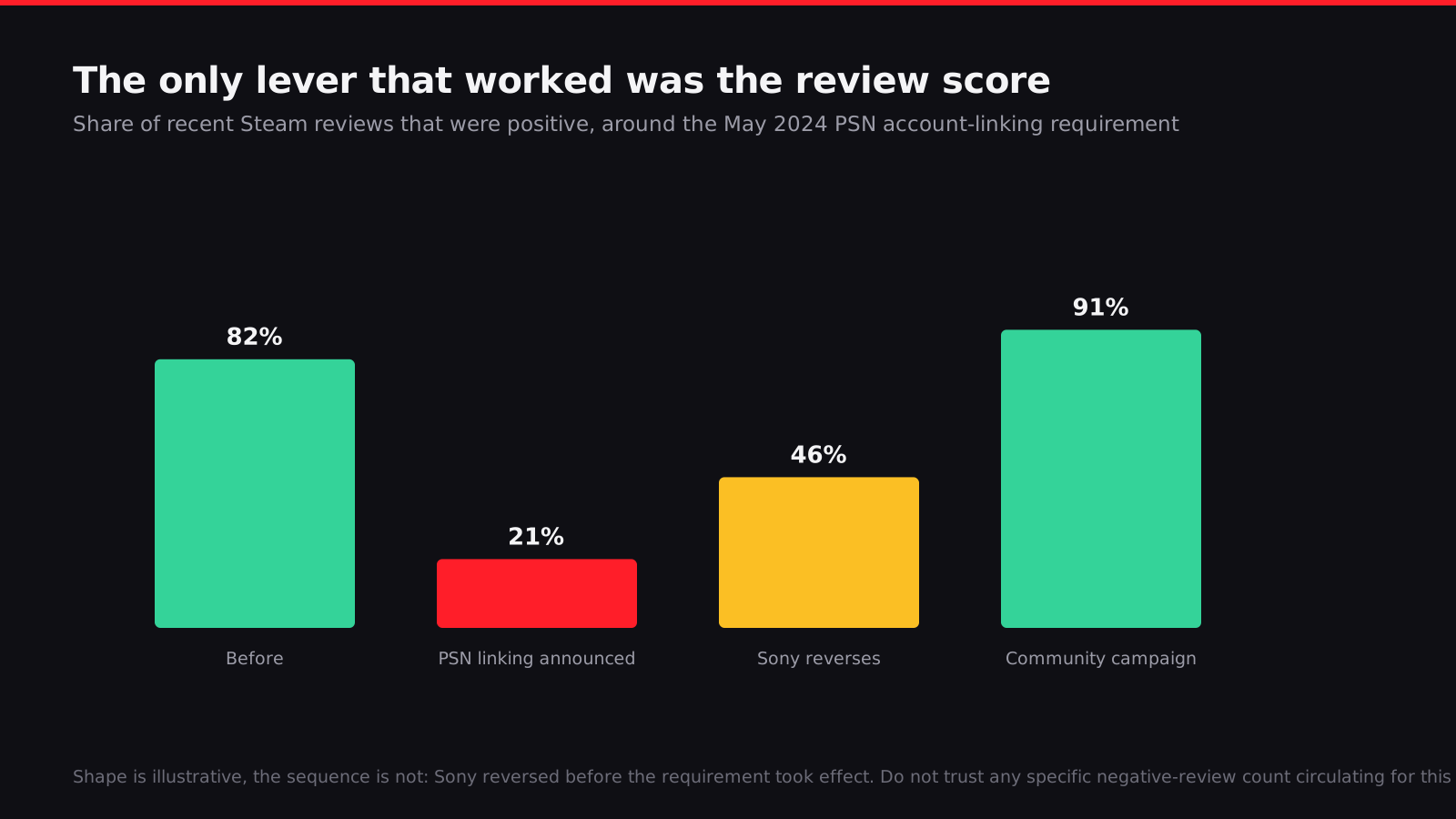
If you want proof the user review can force a publisher’s hand, not just annoy them, look at Helldivers 2 in May 2024. Sony announced that PC players would need to link a PSN account starting 6 May, mandatory, no opt-out. The response wasn’t measured. The game got, in Valve’s phrase for these episodes, “flooded with negative reviews,” and it was delisted from over 150 countries on Steam, because those countries don’t have PSN access and Sony couldn’t sell a game there that required an account nobody in that region could create.
Sony reversed before the requirement ever actually took effect, saying it was “still learning what is best for PC players.” The Steam rating climbed back from mostly negative to mixed almost immediately. Arrowhead’s CEO, Johan Pilestedt, publicly thanked Sony for “quickly and effectively making the decision to leave PSN linking optional.” Then something I find genuinely charming happened: the community turned around and ran a counter-campaign in the other direction. By 4 December 2024, the game had climbed all the way to Overwhelmingly Positive, shedding 2,225 negative reviews and picking up more than 29,000 positive ones in a single month. People went back and changed their own votes once the thing they were angry about got fixed. That’s the system working, more or less, as designed.
It’s worth saying the same weapon doesn’t always fire twice. Helldivers 2 got review-bombed again in 2026, this time over monetisation: undisclosed weapon balance changes, the pricing on the Exo Experts mech warbond, thin free-to-play unlocks, and a growing gap between what you earn and what you’re pushed to buy. Recent reviews slumped to Mostly Negative by 8 May 2026. Arrowhead responded, saying “Helldivers 2 matters to all of us and we want to be clearer about what we’re working on and what’s coming next,” but didn’t reverse anything, and the reaction on Reddit was that the statement was short on actual commitments. The PSN saga worked because Sony could give players back exactly what they’d taken away with a single policy reversal. Monetisation doesn’t reverse that cleanly. There’s no undo button on a warbond price.
A blunt instrument
Here’s the part that should worry anyone who wants to treat the user review as a reliable signal: it mostly can’t tell the difference between a protest and a verdict.
Overwatch 2 took the biggest raw hit of the period, over 52,000 negative reviews within days of its August 2023 Steam launch, dragging it to Overwhelmingly Negative even as it sat inside the top seven sellers by revenue with more than 75,000 concurrent players. A lot of those reviewers had under an hour of playtime logged. That’s not a verdict on the game, that’s a protest vote, cast by people who mostly hadn’t played it, over the cancelled PvE mode and a $15 charge for permanent access to the three-mission Invasion co-op content. Game director Aaron Keller more or less conceded the point later, saying Blizzard “didn’t fully realise it was making a game for itself more than its players.”
Borderlands got bombed again in May 2025, separate from the launch mess, over an updated EULA that a YouTuber called Hellfire flagged in a video that hit roughly 500,000 views. The complaints were about data collection, names, usernames, phone numbers, IP addresses, operating system, and an anti-interference clause some players read as an anti-modding rule. PC Gamer’s judgement on the grounds here was that they were “extremely flimsy,” and I’d go further: nearly all of that data was already handed over the moment anyone created a Shift account, years earlier, for a completely different game. No kernel anticheat got added. Take-Two and Gearbox never issued a statement. The bombing fizzled out on its own within days and changed absolutely nothing about the EULA.
Then there’s Slay the Spire 2, which took more than 9,000 negative reviews in a single day in March 2026 over a change that hadn’t even shipped to the live game yet. A beta patch reworked the Silent’s zero-cost card Prepared, which let you discard one card and draw one, into a version called Prepare that cost one energy, discarded two, and refunded two energy the following turn. Players hated the direction of travel and bombed the beta build before most of them had touched the new card in a real run.
| Bombing episode | What triggered it | Roughly how big | Did it change anything |
|---|---|---|---|
| Helldivers 2, May 2024 | Mandatory PSN account linking | Delisted in 150+ countries | Yes, Sony reversed the policy |
| Overwatch 2, Aug 2023 | Cancelled PvE mode, $15 co-op paywall | 52,000+ negative reviews | No public policy change |
| Borderlands, May 2025 | Updated EULA over data already on file | Short-lived, no verified count | No, no statement issued |
| Slay the Spire 2, Mar 2026 | An unreleased card nerf in beta | 9,000+ in one day | Card change proceeded regardless |
Valve’s filter isn’t the referee people think it is
This is the bit I keep coming back to. Valve actually has a policy for exactly this problem, and it barely gets used.
Back in March 2019, Valve rolled out an off-topic review filter, built to catch “anomalous review activity” across the platform in something close to real time. Confirmed off-topic periods get excluded from a game’s displayed score while staying visible to anyone who opts in to see them. And Valve was specific about what counts as off-topic: anything “unrelated to the likelihood that future purchasers will be happy if they buy the game,” and it names DRM and EULA complaints explicitly as examples.
By that definition, the 2025 Borderlands EULA bombing should have been a textbook case for the filter. It’s about as pure an EULA complaint as you’ll find, complete with a viral YouTube video as the trigger. And yet there’s no sign it was ever filtered out. The score just absorbed it and moved on.
Compare that to Helldivers 2’s PSN bombing, which is also, structurally, an account-linking and DRM matter under Valve’s own definition. That one wasn’t filtered either. It was left to stand, uncorrected, and it’s the single clearest case in this whole period of a review-bomb campaign actually forcing a platform holder to reverse course. So the filter that’s supposed to protect the integrity of the score sat out both a bombing that changed nothing and the one that changed everything.
What Valve’s actually built since 2019 is two blunter tools, not a sharper filter. An August 2024 helpfulness ranking pushes low-effort meme reviews behind substantive ones, but Valve was upfront that it “doesn’t impact how review scores are generated for each game, it is simply changing the order that reviews appear.” And the language-specific scoring Valve added in August 2025, which kicks in once a game passes 2,000 public reviews with at least 200 in a given language, works the same way: it changes what a given player sees, not how the underlying number gets calculated.
So here’s the argument I actually believe: if review bombing functions as real consumer leverage, and Helldivers 2 shows it clearly can, it works precisely because Valve mostly declines to intervene. The filter exists. It’s just not doing much filtering. Whether that’s a deliberate choice about not wanting to referee player anger, or just a policy nobody’s bothered enforcing since 2019, I genuinely don’t know. Either way, the practical effect is the same. Nothing meaningfully stands between an angry mob of one-star reviews and a game’s public score, and every publisher watching Helldivers 2 in 2024 now knows it.
The language split is the strangest wrinkle of all
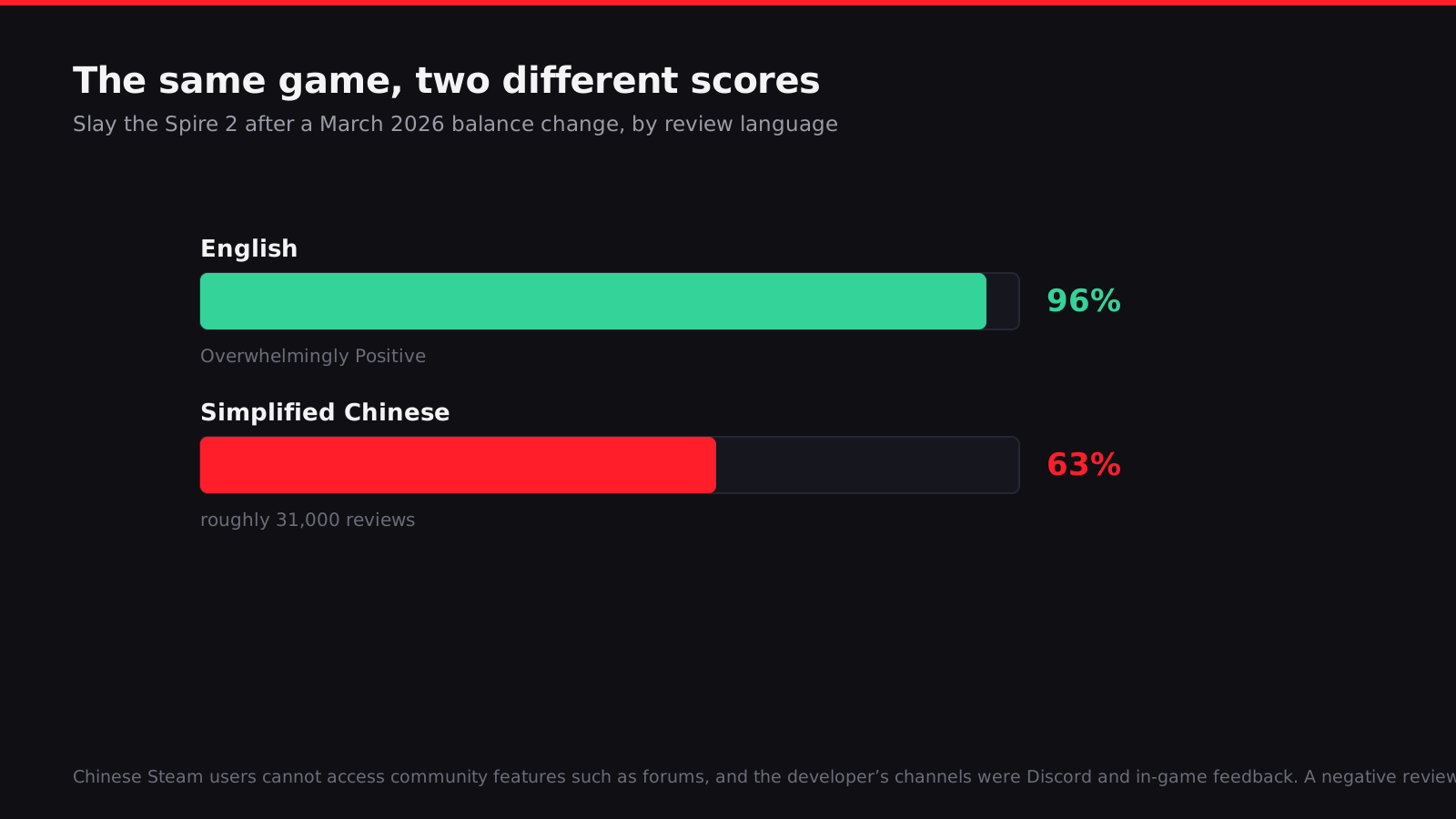
Slay the Spire 2’s language-specific scores threw up something I didn’t expect going in. The overall rating held at Overwhelmingly Positive, 96%, in English. In Simplified Chinese it fell to 63% positive, across roughly 31,000 reviews, over the exact same unreleased nerf.
That gap isn’t really about the card. PC Gamer’s structural explanation is the part worth sitting with: Chinese Steam users don’t have access to the community features a lot of Western players take for granted, no forums in the usual sense, limited Discord access, because Discord itself requires a VPN inside China to reach at all. The developer’s actual feedback channels for the beta were Discord and in-game reports. If you’re a Chinese player and the studio’s main listening post is a platform you’d need a VPN to even open, a Steam review stops being a review. It becomes one of the only doors still open to you.
This isn’t a one-off. Valve’s own example when it launched the feature was The First Descendant, which sat at Mostly Negative in Simplified Chinese while reading Very Positive in Portuguese and Dutch, for the same game, on the same day. PC Gamer flagged a real worry attached to all this, and I share it: splitting scores by language risks turning review sections into something closer to rival national scoreboards, where the interesting story stops being “is this game good” and becomes “which language community is angrier this week.” I don’t think Valve intended that. I don’t think it’s avoidable either, once you’ve built the tool.
Why almost nobody preorders anymore, except when they do
PC Gamer ran a reader poll in June 2026 that’s the hardest data point in this whole piece, and it’s not close. Only 3% of respondents said they preorder games. Twenty-five percent wait exclusively for sales and never pay full price at all. Fifty-one percent pay full price only for the handful of releases they’re genuinely anticipating. Eighteen percent will pay full price for a cheap indie but wait on AAA sales. Four percent are consistent full-price buyers.
And yet, at the top of the market, preorders look completely healthy, they’re just getting more expensive. GTA 6 preorders opened in June 2026 at $80 standard and $100 premium, and Take-Two’s CEO Strauss Zelnick said in August that demand was “skewing more to the premium edition, but that might be a reflection of the fact that the most avid consumers are the ones that are pre-ordering now.” He’s also been clear Take-Two won’t cut the price itself, pointing out the company “preserved our pricing on Grand Theft Auto 5 for a very long time, much longer than a standard release of an entertainment property.”
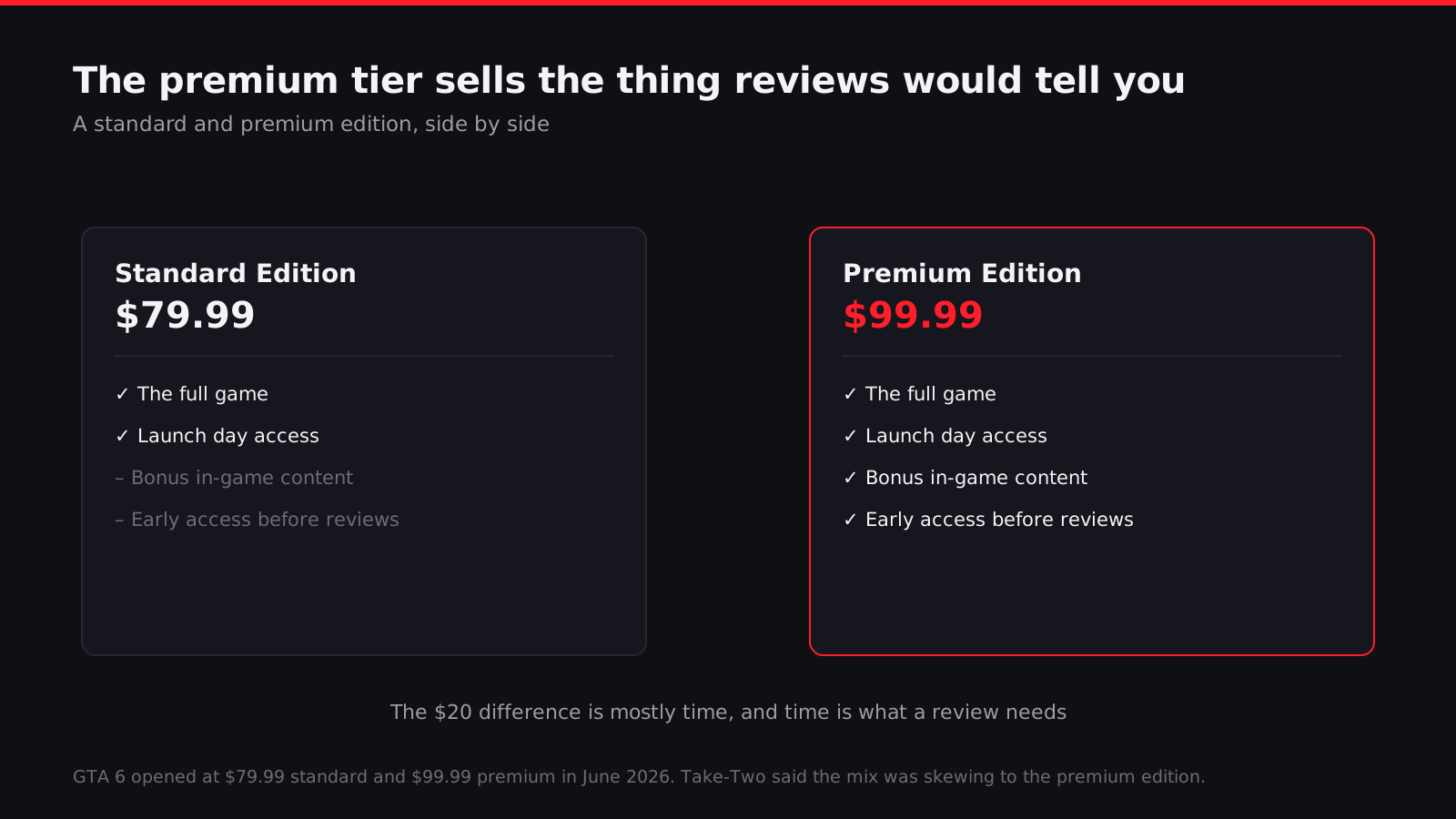
PC Gamer’s read on that $100 tier, and I agree with it, is that it paywalls stores and items the marketing frames as core to the game’s identity, which makes GTA 6 functionally a $100 release wearing an $80 sticker for anyone who wants the full experience. So you end up with two things being true simultaneously. The average reader has apparently stopped trusting the preorder as a purchase method at all, and the biggest release of the decade is still going to sell truckloads of its most expensive edition to the players who care the most. Trust erodes at the bottom of the market a lot faster than it erodes at the top.
Refunds are becoming the other half of that trust conversation. PlayerUnknown’s Prologue went free-to-own in mid-2026 and started offering Steam refunds “without restrictions on playtime or how long ago you bought the game.” A Battlefield 6 player reportedly got a refund approved after 470 hours because a mode got removed. That’s not a policy, that’s a company deciding a generous refund is cheaper than the review score a denial would cost it. Which, honestly, might be the most rational response to all of this that anyone in the industry has come up with.
The fake reviewer nobody asked for
One more thing, and it’s small, so treat it as exactly the headline-level curiosity it is rather than a trend. In February 2026, an AI-generated review of Resident Evil Requiem briefly appeared on Metacritic, credited to a fake “iGaming and sports betting analyst” who doesn’t exist. It got pulled. But it’s a reminder that scheduling isn’t the only thing squeezing the professional review out. Apparently the whole thing is cheap enough to fake outright now, credentials included, and slip past whatever gate Metacritic thinks it has.
So where does that leave things. The Steam user review is a genuinely bad instrument for the job it’s now doing. It’s biased toward whoever’s angriest that week. It’s gameable by a single viral video. It’s frequently unfair to developers who did nothing wrong beyond shipping an unpopular balance patch, and Overwatch 2’s 52,000 one-hour-playtime reviews prove that better than anything I could argue myself. It punishes GSC-style honesty and Gearbox-style deflection with roughly the same blunt hammer, most of the time, regardless of which one actually deserved it.
And it’s still the only part of the stack a publisher can’t schedule around. You can withhold code. You can time an embargo to land after launch weekend. You can sell five days of early access to whoever’s willing to pay for it. You cannot stop a player who already bought the game from typing “not recommended” the moment they hit a wall you knew was there. Sony found that out in six days in May 2024. I don’t think that fact is going away, no matter how many blunter tools Valve bolts onto the side of it.
Read next
The case against preordering, from someone who used to do it constantly
Paid early access moved buyers ahead of reviews and publishers noticed. Here is how the modern release cycle got built, and why waiting two weeks costs you nothing.
What Indie Breakouts Actually Cost, and Why the Numbers Don't Add Up
PEAK broke even in hours on a budget under $200,000. But indie sales numbers are a mess of copies, players and estimates dressed up as fact, and that's the story.
The Steam Machine is the most principled console you probably shouldn't buy
Valve's six-inch cube costs $1,049 because Valve refuses to sell hardware below cost. Here is whether that principle, and the engineering behind it, justifies the money.