
Live Service Games Are Built to Die and Nobody Wants to Say It
Highguard lasted 45 days and Destiny 2 lasted a decade, yet both ended the same way. Here's what that says about a business model that can't survive missing.

On 26 January 2026, Highguard launched with roughly 97,000 people playing it at once. By day two on Steam, that number was under 20,000. By the end of week one, 90% of the launch crowd was gone. Forty-five days after it went live, the servers were switched off and the game stopped existing. Not “went into maintenance mode.” Not “moved to a legacy server with reduced support.” Gone, the way a webpage is gone when someone deletes it.
I keep coming back to that number, 45 days, because it’s short enough to write off as a one-off disaster and I don’t think it is one. It’s the sharpest version of a pattern that’s been running through the entire industry this year, and it’s worth sitting with the specifics before we zoom out, because the specifics are what make it infuriating rather than just sad.
Wildlight Entertainment had real pedigree behind it. Founders Dusty Welch and Chad Grenier, and something like 60 people who’d worked on Apex Legends, Call of Duty and Titanfall. This wasn’t a scrappy studio nobody had heard of swinging for the fences. These were people who had shipped hits before, working on a hero shooter with real money behind it. It still died faster than most people’s Steam backlogs get cleared.
The 45 days, in order
Here’s the timeline, because I think the shape of the collapse matters as much as the total number.
Launch day, 26 January, PS5, PC and Xbox Series: about 97,000 peak concurrent players. That’s a solid number for a new IP. Within 48 hours, the Steam peak had fallen under 20,000. By the end of the first week, 90% of the launch audience had already left. Reviews landed unkind but not brutal, Metacritic sat at 63 on PC and 62 on PS5, and OpenCritic’s recommend rate was 39%. Not a disaster score. A middling one. The kind of score a lot of games survive.
Highguard didn’t survive it. By mid-February the daily peak had fallen to around 1,600 players. Layoffs hit the studio on 12 February, less than three weeks after launch. By the end of that month, the daily peak was under 600. On 3 March, Wildlight announced the shutdown. On 12 March, the servers went dark for good.
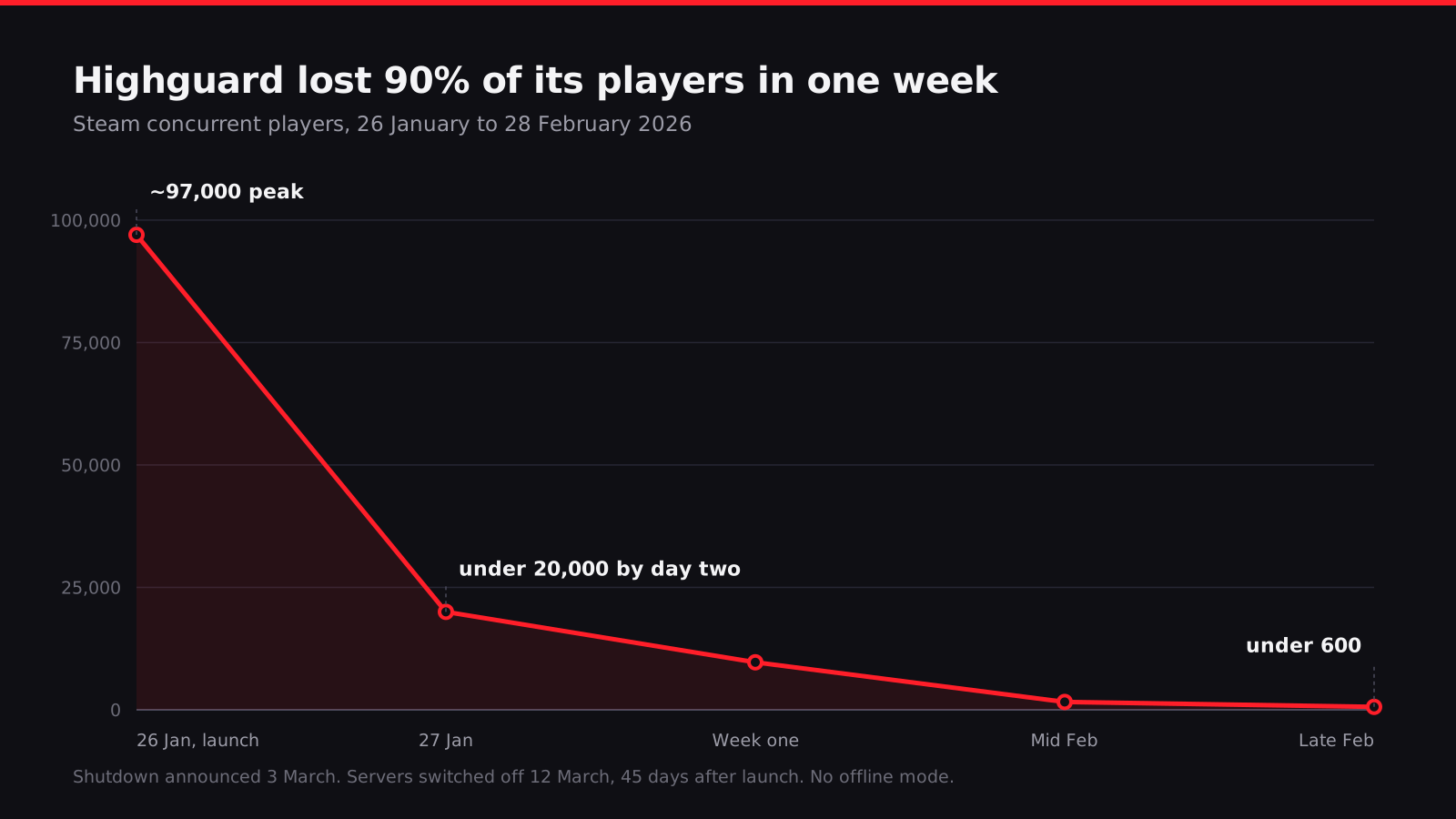
Forty-five days from launch to death. I don’t think there’s a faster live-service collapse from this era, and the brief I’m working from calls it exactly that.
What actually happened during development is arguably worse than the numbers. Bloomberg reported that the project pivoted mid-production, from a survival game into the raid-based hero shooter that eventually launched. That’s the kind of decision that eats years of a development cycle and leaves a team building something they didn’t originally sign up for, under a clock that didn’t move to accommodate the change. And Bloomberg also reported that Tencent was the undisclosed lead financial backer, with financing reportedly tied to retention targets. Read that twice. If true, the money wasn’t just betting on the game selling copies. It was betting on people sticking around, and when they didn’t, the funding logic that kept the lights on evidently stopped making sense.
Wildlight’s own statement on the shutdown was the standard genre of corporate non-apology: “We’re proud of the team, talent, and the product we’ve created together.” Sony started issuing automatic PS5 refunds on 18 March. That’s usually a sign a publisher knows exactly how badly a launch went, because you don’t proactively refund a game people are still happily playing.
That’s not a Highguard-specific design flaw, either. It’s standard practice for the genre. Live-service games are built assuming the servers will always be there, right up until the day someone decides they won’t be, and then the assumption just evaporates along with the game.
Why the bet keeps getting made anyway
It’s worth asking why a studio stacked with veteran talent signs up for this risk in the first place, because the answer isn’t stupidity. It’s math, and the math has gotten worse this year, not better.
Xbox cut 3,200 jobs and shed four studios on 6 July 2026. Asha Sharma, now running the division after Phil Spencer’s retirement in February, put it plainly: Xbox “lost 64 cents for every dollar invested” in some of its studios, and pointed to a “severe hardware crisis” driven by memory prices climbing as AI data centres soak up supply. Nintendo raised Switch 2 prices for similar reasons in May, President Shuntaro Furukawa citing the same component cost pressure. Component costs going up and console prices going up at the same time squeezes margins from both directions, and a single-purchase game with no ongoing revenue looks worse and worse against that backdrop compared to something that can, in theory, keep billing players for years after the box art stops mattering.
That’s the appeal of live service in a boardroom. One good year of seasons and battle passes can outearn a boxed release several times over, and everyone remembers Fortnite’s numbers even a decade on. What doesn’t get remembered as clearly, or at least doesn’t get priced into the pitch deck, is that the format also multiplies the downside. A boxed game that undersells still has a shelf life. A live-service game that undersells has a countdown clock, and somebody upstairs is watching the retention graph decide when to start it.
Destiny 2 proves “good” isn’t the bar
If Highguard is the fast, ugly version of this story, Destiny 2 is the slow one, and it’s the one that should worry people who assumed quality was the thing protecting a game from this fate.
Bungie announced on 21 May 2026 that the update landing 9 June, called Monument of Triumph, would be Destiny 2’s final piece of live content. The game itself stays online and playable, the way the original Destiny still does, but the ongoing seasons, the new raids, the content drip that defines what “live service” means, that part is over. This is a franchise that’s been running since 2014. It worked, by most reasonable definitions of the word, for over a decade.
It ended anyway. Sony booked an impairment loss of roughly $765 million for the fiscal year ending 31 March 2026, tied directly to Bungie underperforming against whatever numbers justified the original $3.6 billion acquisition. On 25 June 2026, Sony laid off nearly 300 people, including most of the team working on Destiny. Marathon, Bungie’s other project, is now the studio’s primary focus with no dated release, under new CEO Justin Truman after Pete Parsons departed.
I don’t think Destiny 2’s ending is a scandal the way Highguard’s is. Nobody’s game vanished overnight with zero warning and a hollow statement. Bungie gave players a defined endpoint and the game world keeps existing. That’s about as graceful as this genre gets. But it still proves something uncomfortable: being good, being long-running, being a game people genuinely loved for ten years, none of it is a guarantee. If the retention curve and the revenue curve stop pointing the direction a parent company needs, the live content stops. A $765 million writedown doesn’t care how many raid completions your community logged.
The 2026 shutdown roll call
Highguard and Destiny 2 are the headline cases, but they’re two entries on a much longer list. Here’s a chunk of what actually closed or wound down in 2026, and I want to be upfront that this list mixes genuine failures with games that just reached a natural end of support, because lumping them together is exactly the mistake people make when they talk about this trend.
| Game | Shutdown / end date | Note |
|---|---|---|
| Anthem | 12 Jan 2026 | Long-dead in practice, formally closed |
| Beat Saber (PS4/PS5) | 26 Jan 2026 | Platform-specific wind-down |
| Highguard | 12 Mar 2026 | 45 days from launch |
| The Finals (PS4) | 18 Mar 2026 | Platform-specific, PC/other consoles unaffected |
| Genshin Impact (PS4) | 8 Apr 2026 | Older hardware dropped, game continues elsewhere |
| Fortnite: Ballistic | 16 Apr 2026 | Spin-off mode cancelled |
| Call of Duty: Warzone Mobile | 17 Apr 2026 | Mobile spin-off shuttered |
| Destruction AllStars | 27 May 2026 (announced) | PS5 exclusive, five years old |
| Destiny 2 (live content) | 9 Jun 2026 | Game stays online, seasons stop |
A few of those, Genshin on PS4 and The Finals on PS4, are older hardware getting cut loose while the actual games carry on fine elsewhere. That’s normal platform lifecycle stuff, not failure. Destruction AllStars lasted five years, which by live-service standards is a decent run for a PlayStation exclusive nobody was talking about by year two. Fortnite: Ballistic and Warzone Mobile were spin-offs, not the core products, cut because they weren’t pulling their weight next to games that were. Anthem was already a corpse everyone had stopped visiting, this was just the paperwork catching up.
Highguard is the only one on that list that’s a pure disaster from a standing start. But look at how long the list is regardless. That’s the actual point. Even setting aside the outright failures, the live-service model produces this much churn as a matter of course, constantly killing off products, spin-offs and platform versions as part of normal operation, before you even get to the games that flat-out flopped.
There’s a category this table doesn’t fully capture, too: games killed before anyone outside the studio ever got to play them. The Last of Us Online, Naughty Dog’s multiplayer Last of Us project, was reportedly around 80% complete when it was cancelled on 2 April 2026. Eighty percent. Not a pitch deck, not a vertical slice, an almost-finished game that a AAA studio decided wasn’t worth crossing the finish line on. Giant Skull’s untitled Dungeons & Dragons game, Quantic Dream’s Spellcasters Chronicles, Black Forest Games’ TMNT: The Last Ronin, all cancelled in 2026 before launch. You don’t see concurrent-player graphs for those. They just stop existing in a different, earlier way.

Where it actually works
Here’s where I want to push back on the doom narrative, because it would be lazy to write three thousand words saying live service is cursed and leave it there. It isn’t. Two of 2026’s clearest successes prove that.
Arc Raiders, from Embark Studios, launched 30 Oct 2025 and by February 2026 had sold 14 million copies, a number confirmed in a Nexon earnings filing rather than a marketing tweet, which matters. Embark CEO Patrick Söderlund was made executive chairman of Nexon off the back of it. That’s not a game limping to relevance. That’s a genuine hit, reviewed well (88 on Xbox, 86 on PC, 85 on PS5 via Metacritic, 92% recommend on OpenCritic) with one loud dissenting voice, Eurogamer’s 2/5, largely over the use of AI-generated voice work. Embark denied replacing anyone, said voice actors were hired with text-to-speech included in the contract terms, and by March had quietly re-recorded some AI lines with human actors after players flagged a “noticeable quality difference.” Worth knowing, not disqualifying.
Battlefield 6, released 10 Oct 2025, sold 7 million units in three days, became the best-selling game in the US that year, and did something the franchise had never managed before: it outsold Call of Duty, specifically Black Ops 7. That’s a first in Battlefield’s entire history against the biggest shooter franchise on the planet. Its free-to-play battle royale mode, REDSEC, launched shortly after as a separate hook into the same audience, giving DICE a second revenue lane without betting the whole release on it.
Neither of these launched into a vacuum, and I think that’s the part that gets skipped when people wave Arc Raiders around as proof live service just works if you’re good enough. Battlefield had a competitor visibly stumbling and a built-in fanbase that had been asking for exactly this kind of return to form for years. Arc Raiders had a genre already primed by Escape from Tarkov and its imitators, an audience that showed up already knowing they liked extraction shooters and just needed a reason to pick this one. Neither studio was asking players to fall in love with a completely unfamiliar concept from a standing start, the way Wildlight was with Highguard’s hero shooter pivot.
So what actually separates Highguard from Arc Raiders and Battlefield 6? I don’t think it’s mysterious, and I don’t think it’s really about quality either, Highguard’s Metacritic scores weren’t catastrophic. My honest read is that both of the successes had something to attach to that wasn’t just “trust us, this will be good.” Battlefield had decades of franchise recognition and a competitor that had visibly stumbled the year before. Arc Raiders had Embark’s prior work and a genre, extraction shooter, that had built its own hungry audience before Arc Raiders showed up to serve it. Highguard had a new IP, a mid-development pivot away from what the team originally set out to build, and reportedly financing that expected retention numbers a brand-new hero shooter had no real track record of hitting. It wasn’t cursed. It was underwritten by assumptions that didn’t survive contact with launch day.
The actual argument
Here’s my honest take on all this, and I think the evidence in front of me supports it: the problem with live service isn’t that the games are bad. Some of them are genuinely good. The problem is the business model requires a hit rate the industry hasn’t been able to sustain, and it punishes a miss in a way no other kind of game gets punished.
Think about what happens when a normal single-player game underperforms. It sits there. Nobody’s playing it, sure, sales were disappointing, the studio might not get a sequel greenlit, all bad outcomes. But the game still exists. Someone can buy it in five years, in ten years, and play it exactly as it shipped. A commercial failure in that world still leaves an artifact behind.
A live-service miss doesn’t leave an artifact. It leaves a folder of assets nobody can access and a refund email. Highguard isn’t a game that undersold, it’s a game that no longer exists in any form a person can experience. That’s a categorically different kind of failure, and I think the industry has spent years treating it as an equivalent business risk to a slow-selling single-player release when it very obviously isn’t. The downside isn’t “we made less money than we hoped.” The downside is “the product is erased and everyone who paid for it owns nothing.”
And that risk profile is exactly why the model keeps producing casualties even when individual teams do good work. You need a hit rate that a hits-driven industry has never actually had, in any genre, at any point in its history. Most games underperform expectations. That’s just true, always has been. Live service takes that ordinary, survivable rate of failure and turns every single miss into a full extinction event, for the product and often for the studio around it. Sixty industry veterans built Highguard. A meaningful chunk of them were out of a job within three weeks of launch.
Compare that to what happened at Ubisoft this year. The publisher restructured into five genre-based “creative houses” in January and cancelled six games outright, including a Prince of Persia: The Sands of Time remake that had presumably eaten years of somebody’s career. Painful, absolutely, and Ubisoft Halifax closed with 70 people losing their jobs. But those were mostly pre-launch calls, projects cut before they shipped and disappointed anyone who’d paid for them. Vantage Studios, the Tencent-backed subsidiary that now handles Assassin’s Creed, Far Cry and Rainbow Six, took a €1.16 billion investment at a €4 billion valuation around the same time, which tells you Tencent still sees plenty of upside in games as a service when the fundamentals look right. Tencent was also the money behind Highguard. Same investor, wildly different outcome, because one bet was backed by franchises with twenty years of proven demand and the other was backed by a genre pivot and a hope.
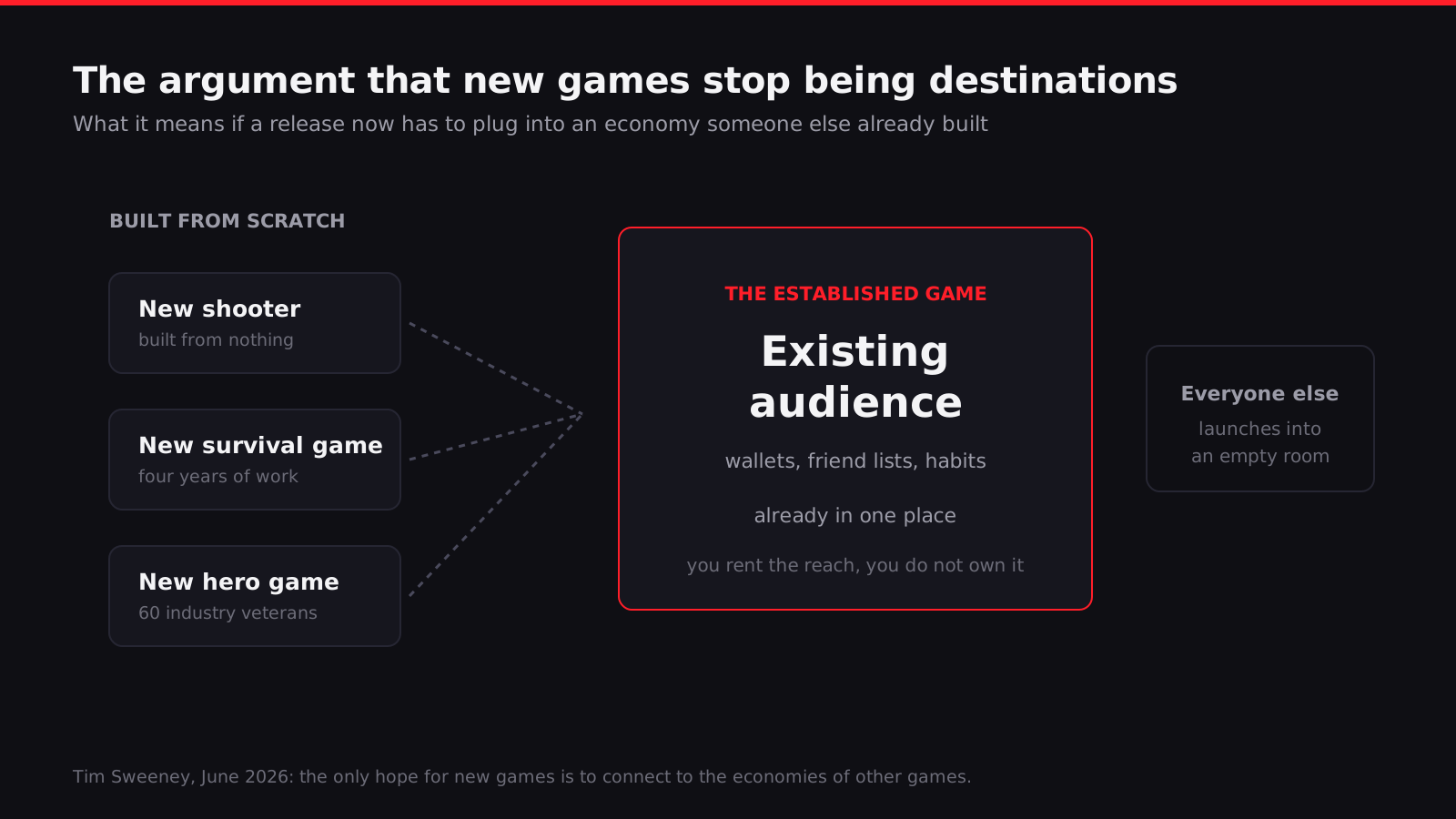
Tim Sweeney said something on 24 June 2026 that I think is the bleakest honest sentence anyone’s put on this topic all year. He said the only hope for new games now is to “connect to the economies of other games.” Sit with that for a second. The founder of Epic, a company that has spent a decade building exactly this kind of connective infrastructure, is saying the path forward for a new game isn’t standing on its own anymore. It’s plugging into somebody else’s already-proven economy, because building a fresh one from scratch is too risky to bet a studio on.
If that’s actually where this is heading, and I think it’s a genuinely plausible read of where the money is pointing, then the games that get made in five years look less like new worlds and more like tenants. Skins, modes and events living inside Fortnite’s economy or something built the same way, rather than standalone universes asking players to trust a brand-new retention curve with their time. It’s a smaller, safer, more boring version of what live service originally promised.
What I keep landing on
I don’t think every live-service game is doomed, and Arc Raiders is proof enough of that on its own. But I do think the industry has built a funding and greenlighting model that treats a category-ending failure mode as an acceptable, routine business risk, and I don’t think that’s sustainable at the rate 2026 has been producing casualties. Anthem, Highguard, Destruction AllStars, an 80%-finished Last of Us game that never shipped at all, a decade-old Destiny finally cut off at the knees. That’s one year.
The publishers keep calling each shutdown an isolated business decision. Forty-five days between a launch trailer and a dead server says otherwise.
Read next
You Don't Own Your Games. Europe Just Confirmed It, Politely.
Nearly 1.3 million people signed a petition asking Europe to guarantee games stay playable after shutdown. Brussels said it legally can't, and offered a voluntary code instead.
The case against preordering, from someone who used to do it constantly
Paid early access moved buyers ahead of reviews and publishers noticed. Here is how the modern release cycle got built, and why waiting two weeks costs you nothing.

Microsoft priced day-one Call of Duty twice and the answer was no
Game Pass Ultimate went to $29.99 with day-one Call of Duty, then down to $22.99 without it. Microsoft ran the experiment in public and published the result.